
County News
Looking to the future
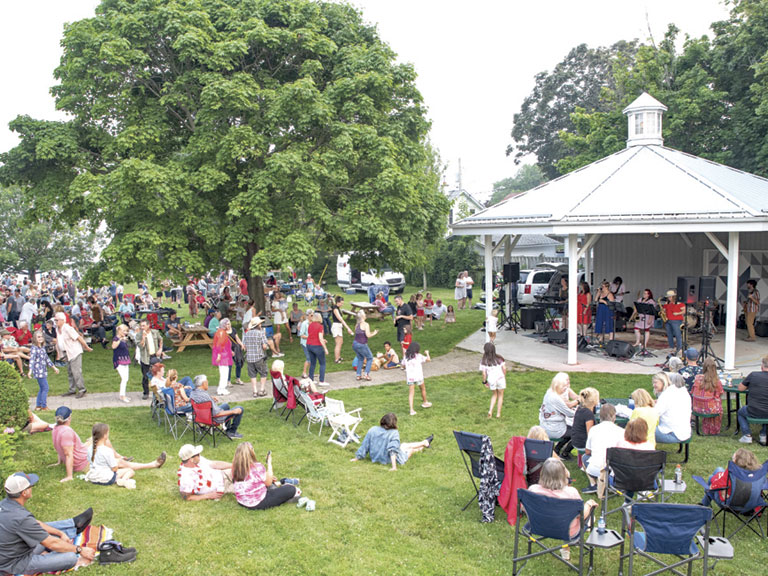
Council endorses first-ever Parks and Recreation Master Plan
Four years after work first began, Prince Edward County’s inaugural Parks and Recreation Master Plan has gained the support of councillors, receiving endorsement at last Thursday’s Committee of the Whole meeting.
Described as the County’s first comprehensive roadmap for parks, recreation facilities and service delivery, the 10-year plan lays out 55 recommended action items and sets priorities for investment in parks, open spaces, amenities, events, and community facilities. Equity, accessibility, and long-term sustainability form the backbone of the strategy.
“This is the County’s first comprehensive plan for parks and recreation and it addresses demographic shifts, aging infrastructure and growing demand for inclusive and accessible recreation,” said Lisa Lindsay, Director of Recreation and Community Facilities. She noted the plan will guide capital planning, asset management, and operational budgeting “to ensure recreation services evolve in step with community needs.”
The plan is built on three pillars—community recreation hubs, service delivery excellence, and parks and outdoor facilities—supported by a set of strategic directions and timelines ranging from short-term to long-term implementation. It aligns with the County’s Strategic Plan, the Asset Management Plan, and Accessibility for Ontarians with Disabilities Act (AODA) standards.
Council agreed to direct staff to review and update the facility rentals and ice allocation policy, scheduled for 2026, to clarify equitable access to municipal facilities and ensure optimal use of available ice time. Staff will also review the terms of reference for recreation committees and consider ways to realign their functions to better reflect their broader community roles.
A motion from councillor Phil St-Jean to accelerate two action items—from a three- to five-year window to one to two years also carried. Those include evaluating under-used County-owned parkland parcels and developing a disposition policy.
Lindsay’s report notes the plan is designed to help the County respond to its aging population, growing communities in Picton and Wellington, greater demand for recreation opportunities, seasonal population pressures, and the challenge of serving a large geographic area with finite resources.
Councillor Brad Nieman raised concerns about a section of the report outlining risks the County faces if the plan is not implemented, including fragmented service delivery and inconsistent decision-making.
“What this report is telling us is we have not really managed our department here very good,” Nieman said. “I am a little disappointed that this is coming like this; it’s giving us a black eye to say that we are not doing our jobs.”
Lindsay responded that the plan is forwardlooking rather than a critique of operations.
“Right now, we are continuing to budget to the best of our ability and replace what is in most desperate need of repair,” she said. “What this plan is talking about is having guiding principles on how we are moving forward.”
Nieman also pointed to unused allotted ice time. “We are shooting ourselves in the foot when we are limiting people to use that ice when it’s not being used,” he said.
CONSULTANT: ADOPTION IS CRITICAL
Jonathan Hack of Sierra Planning and Management, the lead consultant on the plan, emphasized that adopting the plan is essential.
“The worst thing in the world for a municipality to have is a master plan that is received for information but is not adopted,” Hack cautioned.
He stressed the plan complements the County’s Asset Management Plan but offers broader direction. “If you have a good Asset Management Plan and a good Parks and Recreation Master Plan, both Council and staff are going to have the tools they need to make decisions.”
Mayor Ferguson noted he was happy that the lengthy process, which began in 2021 had created this document, as he couldn’t identify anything that had been overlooked.
“I am thankful that this plan has come forward to this council. It is an extraordinary document. There is so much in this, it is a lot to digest, but it is a guiding document. I want to thank staff very much for the work that has been put into it,” he said.
DEMOGRAPHICS
Councillor John Hirsch questioned the background data suggesting the County’s population is aging, pointing to rapidly filling schools and an influx of younger families.
“I would argue strongly that that has changed,” Hirsch said. “Our schools are full to overflowing; younger families are moving in.”
Hack acknowledged shifts accelerated by the pandemic and noted new census data expected next year will give a clearer picture.
“We always say places are growing older because Canada is growing older as a country,” he said. “But in individual places, you need to recognize places are also growing. I think the County is going to be growing younger. It’s still older as a profile, but our plan does take that into account.”
The master plan cost $97,000 to develop, funded from the County’s Capital Sustainability Reserve and Development Charge revenues. Sierra Planning and Management led the work alongside the MBTW Group and WGD Architects.
The full draft plan, including all 55 recommended action items, are available on the County’s website.
Comments (0)