
County News
Back to earth
Downward revision to population growth expectations reveals defects in infrastructure plan
Shire Hall has, at long last, admitted that its population growth assumptions were wrong. Wildly wrong. Big time wrong. According to a report to be presented to a council committee meeting tomorrow (Thursday), Shire Hall staff no longer believe the County’s population will grow at 2.4 per cent per year.
The report concedes that population growth will likely be more in the range of one per cent. (They acknowledge further that the population growth rate may be even lower, but for infrastructure planning purposes, they are choosing to have some cushion in waterworks capacity rather than get caught short a decade or two down the road.)
It’s a massive correction. A 2.4 per cent population growth rate was anticipated to result in 438 new homes each year. A lot of infrastructure expansion would be needed to keep up with that pace of new homebuilding. Worse, as the report notes, much of it would have had to be built upfront—funded by existing ratepayers—until the new homes showed up.
A one per cent increase, however, means a pace of 150 new homes annually. It is still higher than the County’s average new homebuilding rate (125 new homes annually over 25 years), but it is a more credible expectation. (Just 96 new home permits were issued last year.)
Shire Hall’s revised pace of new homebuilding will require a much more modest infrastructure upgrade. But that is not what is happening. Not yet anyway.
Such a fundamental revision to the foundational premise should spark a serious rethink about what is needed. And while it might get there, Shire Hall is still considering pressing forward with its “unfinanceable” original plan by merely stretching out the time frame for paying for it all. Think of it as a layaway plan for a $400 million infrastructure purchase over 44 years.
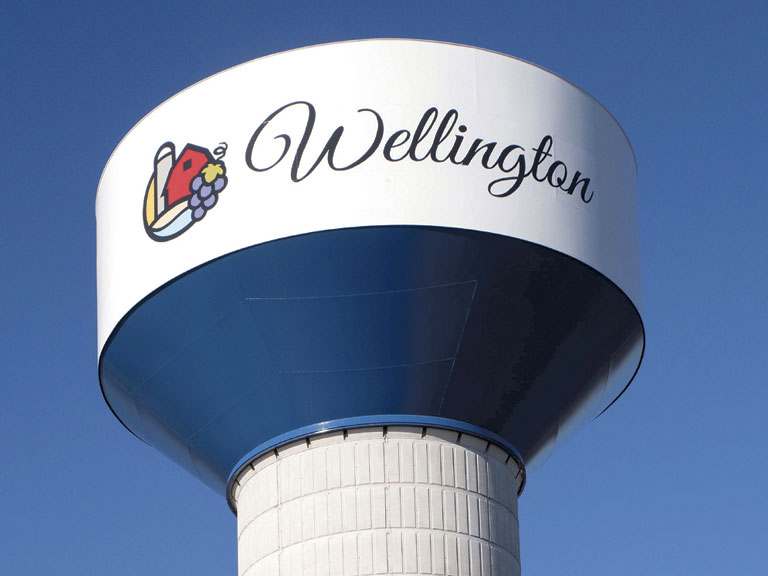
In the near term, Shire Hall still plans to build a mega regional plant in Wellington to serve Picton (at a cost of $40 million). It will, however, postpone installing the connecting 20-km pipe ($102 million) until after 2040.
Shire Hall is admitting it made a fundamental error in estimating the pace of new homebuilding in Prince Edward County, but so far, it is unwilling, perhaps unable, to make a full course correction.
WHY?
Rather than starting with a fresh piece of paper and evaluating all available options through the lens of its revised growth projections, Shire Hall— for now—is returning to its original plan, hoping that time fixes all mistakes.
The report talks about potentially wasting money it has already spent on a detailed design for a regional water plant (based on faulty assumptions). It also worries that a provincial grant ($18.3 million) awarded to enable new homes under the original plan could be taken back. It fears that Highway 49 funding may also be put in jeopardy if it reverses course on the regional water plan.
The province taking back money because the market has changed seems implausible, but perhaps a bigger hurdle is that thick wads of studies, reports and funding applications were produced over the past five years using these unrealistic forecasts. Shire Hall can’t simply wave those all away.
But neither can it ignore the risks of overbuilding infrastructure without a means to pay for it. It must, instead, discern the true capacity and condition of its existing systems. It must stop.
A POTENTIAL OFF-RAMP
To do this, Shire Hall is seeking a “complete, detailed condition assessment of the existing Picton and Wellington water treatment plants.” It will seek a third-party engineering firm to understand the state of these plants, their remaining capacity, and to assess what “upgrades are required to extend the useful service life of the facilities for a minimum of 20 years.”
Only when these assessments are completed, and a report is delivered to Council can a decision to depart from the regional water plant be considered.
Until then, the regional water plan remains the “preferred solution”—as perverse as it may seem.
HOW MUCH NOW?
Shire Hall has already committed $39 million in Wellington (water tower, an EQ tank, partially installed trunklines, water and wastewater, and a hole for a sewage pumping station).
The report offers no indication of whether or how much the partially completed components are currently over budget—or how much it will cost to complete them. Yet, the new report boldly calls for spending $77 million in the near term (on a regional water plant and a sewage treatment plant in Wellington).
Moving project costs out over a longer time horizon will raise the overall costs from $310 million to $409 million. While the original plan was deemed “unfinanceable,” the revised plan will cost considerably more, but gives the municipality a longer period to fund the works.
The report estimates that $68.7 million will need to be added to the development charges study currently underway and to waterworks rates starting next year. It cautions that under any scenario, existing water ratepayers will be required to fund a portion of these costs. “The full $68.7 million [amount to be spent immediately] would not be recoverable through development charges.”
Development charges are, in and of themselves, another leap of faith. These fees are paid only if and when the thousands of new homes predicted—even under much lower growth expectations— are actually constructed. Until then, it is existing water ratepayers who must underwrite this uncertain future.
Given Shire Hall’s demonstrably poor track record in predicting new homebuilding in Prince Edward County, it must stop. And reassess.
FOUNDATIONAL ERROR
It was never clear where Shire Hall got the 2.4 per cent growth rate in the first place. In 2017, the County’s consultants, Watson and Associates, used a one per cent population growth rate to determine development charges in the County. In 2023, Watson again predicted a one per cent growth rate as part of a regional growth analysis.
Earlier that year, Watson had indeed wedged a 2.4 per cent growth line into a County-funded study, while maintaining that 1 per cent was their reference scenario reflecting “ a market-based forecast, factoring regional and local growth drivers, and broader demographic and economic trends, along with housing demand and supply considerations.”
It seems no one at Shire Hall was listening. Instead, the then-CAO cobbled together lists of new homebuilding projects they believed were “imminent”. Plans were drawn up that envisioned Wellington growing from 2,000 people to 14,000 and the infrastructure required to serve them. Similarly, Shire Hall was bracing for Picton’s population to explode from 5,800 folks to 32,600.
It was obvious to most ordinary observers that growth in Prince Edward County was overstated— that it was far surpassing historical trends, provincial forecasts, and its own demographic consultant’s projections.
It was obvious, too, that relying on such growth forecasts would result in vastly overbuilt infrastructure without the new homes to pay for it, shifting this financial burden onto water ratepayers and, ultimately, County taxpayers.
The risks were obvious to everyone—except then-senior leadership and a majority of Council.
The truth is that even a one per cent growth rate may be ambitious. The County’s population has fluctuated within a vanishingly narrow band for the past 140 years. Between 2006, four censuses ago, and 2021 (the last census), the County’s population increased by just 208 souls, essentially a zero-growth rate.
In 2025, just 96 homes were built in Prince Edward County. Given the County’s demographic profile— a large and growing cohort of seniors, and fewer individuals residing in each home—it is reasonable to expect that the 2026 census may reveal that the County has experienced another five years of low to no growth in population.
UNFINANCEABLE
The foundational error might never have been acknowledged had so many community members and the Wellington councillor not extracted the promise, in August 2024, that further infrastructure upgrades would not happen until the completion of three critical milestones: 1) the County must implement program management (roadmap, timelines and such), 2) establish a cost recovery plan and 3) prepare a communications framework to provide transparency to stakeholders.
The report prepared for Thursday’s meeting concludes the original plan was “unfinanceable”.
“Based on current resources, the Municipality would likely be unable to fund the planned capital projects without additional external support,” wrote Cristal Laanstra, Director of Development Services.
The insistence on a cost-recovery plan revealed that the original plan was never going to work.
I met our Ms. Wallace at an information meeting in Bloomfield about 2 1/2 years ago.
I walked to Ms. Wallace and I told her point blank “I don’t believe a word you’re saying”. Her jaw literally dropped on the floor and she was staring at me with wide surprised eyes unable to talk.
She had NEVER heard anything like what I had said. Obviously she had never been challenged and Fergie, (the one and only one) jumped in between the two of us to stop the conversation. I guess he needed to be protect her from hard facts.
If you choose to run for election, it is supposed to be a selfless act of giving back to your community. You represent the interests of everyone in your chosen Ward. I heartily commend your intention to do so – this is a very demanding “part time” job, but the hours you really do work will not reflect that.
But run for office without accepting any campaign donations. If you feel it is necessary to accept donations, then very carefully vet those donors personally – know who they are. Do not accept any donations from anyone who you know, or should reasonably be expected to know, that they, or anyone representing their particular interests, will come before you in Council, in Planning and Development Committee and any other Committee during your four year tenure.
And if you have a personal project (like a resort/spa/entertainment venue) that you are engaged in, either: refrain from running or put it on hold until the end of your four year term. Your constituents deserve nothing less, and would correctly demand their full representation through you at Shire Hall.
Finally, any elected official should declare a Conflict of Interest each and every time a relevant issue advances at Council. Again, 2026 allows the opportunity for councillors to represent the interests of residents who elected them.
Over and over again, everyone outside a small circle of County Staff, a majority of the 13 Councillors, the Mayor, and certain outside interests, consultants and contractors — seems to say “these folks are being unrealistic in their plans”.
The thing is — they know, and always knew, as we do, that the plans are unrealistic. It was never about realism. It was, and continues to be, a way to separate the County treasury and taxpayers, from their cash.
Everything the small circle mentioned above does, has only that goal in mind. As the old saying goes, “follow the money”. And the money is rushing out of the County treasury at breakneck speed, even as press coverage such as this suggests that maybe there may be a reversal of this.
There won’t be, unless and until a new Council and Mayor are elected this year that truly wish to stop the madness, clean house and right-size County Staff for a population of 25,000 permanent souls, and get back to basics and stop the transfer of wealth from over-stressed County taxpayers.
We’ll see what happens in 9 months time. If the same Council and Mayor are elected, you may see change. But the change will just be in the tactics, not the strategy. The strategy will continue to be spend, baby, spend. Because that’s what they do. And the outside interests, consultants and contractors are enjoying that immensely.
Always the voice of sanity. Thank you.
“Council Code of Conduct” is on tonight’s Council Agenda and concerns us all. A Deputation is to be presented on this matter by a concerned resident.
LINK: See Item 9. Deputations; Item 9.1 Deputation by Paul Allen
https://princeedwardcounty.civicweb.net/Portal/MeetingInformation.aspx?Org=Cal&Id=3588