
County News
WCIA fundraiser
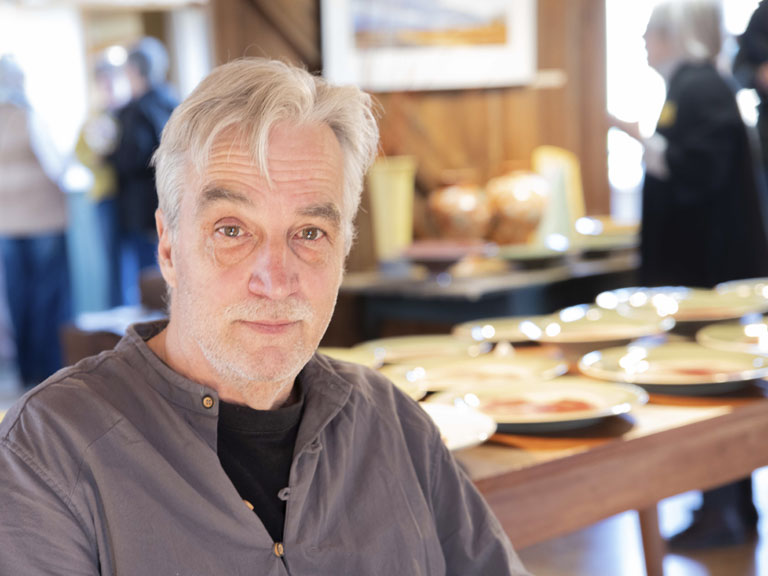
Porcelain works by Bill Reddick for sale at Mad Dog Gallery
The Waring’s Creek Improvement Association (WCIA) has been working to preserve and protect the Waring’s Creek watershed and cold water stream since 1993. The group has worked tirelessly and has had a number of successes over the years. Recently, however, in addition to bringing its concerns before the municipality, the WCIA has appeared before the Ontario Land Tribunal to argue against a massive development in Picton that they believe poses a significant danger to the watershed, and one that could affect the drinking water of hundreds of residents. To pay for legal representation—as well as a host of other things, including baseline well water testing along County Road 1—the WCIA has taken up a number of fundraising initiatives. One of these is taking place at Mad Dog Gallery until May 2, with a number of significant works by master ceramicist Bill Reddick being offered for sale, with the proceeds going to the WCIA. Cheryl O’Brien of the WCIA said the group is not totally opposed to development, but wants to see it managed with a focus on protecting the environment. “This is arguably the best farmland in Prince Edward County, and is also the most sensitive at the headwaters of the creek. The County has made it clear the land would be developed. What we’ve been trying to do is manage the extent of the development. It is impossible to stop these developments now, but we are hoping the developers will work with us to manage the development so that it will not ruin the creek, the water table and the headwaters. Our job is to make sure the land survives development and still provides water to the community and the cold water stream,” she said.
Mr. Reddick is a long-time supporter of the WCIA, and held his first fundraising event— also at Mad Dog Gallery—28 years ago when he had a studio in the County. He had moved to the County around 1982 and established himself as a potter, making as he put it “functional stoneware— cups, mugs, dishes.” After 15 years of doing that he decided to challenge himself to making porcelain, inspired by the work of Kayo O’Young, a master of the craft nearby in Quinte West. “I gave myself an ultimatum at the age of 37. It was time to make a change and fulfill my potential and to put my creativity into my work,” he said. He started to push his boundaries and learned as much as he could about the art of porcelain making. Three years later, he was invited to China for the first international ceramic art conference. A year after that he was asked to make dinnerware for the Canadian Embassy in Tokyo, and two years later was commissioned by then Governor General Adrienne Clarkson to make Canada’s official state dinnerware for Rideau Hall. “This was a lesson in taking that risk. There was a reward. It led to a more exciting path for me, and I use my work more as a creative thing,” he said.
It was a long process to learn about glaze chemistry. He did huge numbers experiments to find out how the glaze chemicals react to the heat and the oxygen content in the kiln. He was particularly interested in a red glaze called the Sacrificial Chinese Red that he said reached its peak in 1426 during the reign of the second emperor of the Ming Dynasty. “After 700 years of evolving, we now have what is called the Monochromatic Red. Even if you get the formula correct, it’s all determined by very fine control of the kiln. So the kiln will decide if it’s going to be red or not; it can be yellow, it can be green, it can be a partial red, it can be an abstract. The goal is to make a perfect red. You’re taking a process that is very primitive and unpredictable and trying to control it. It’s a formula for going insane. During the tortuous two years of creating the 45 plates for Rideau Hall I made 300, because what I learned was how many different ways the glaze can fail. I now have an order for eight of those plates, but I will likely have to make as many as 30 to get those,” he said.
Mr. Reddick moved away from the County 13 years ago, to Peterborough, and last year was told he had to move out of his rented space. Decades of creating had left him with untold boxes of pieces, some remaining unopened since his move from the County. In the process of clearing out, he found 17 boxes of porcelain that he’d made in his County studio. “I thought I could donate them back to the County where they were made—return them back home—and also serve in supporting the cause for the WCIA,” he said. “These pieces really represent my history. Some of the work is from the eighties and early nineties. When I look at it now, I can remember that period in my evolution. There’s a certain amount that I developed in an effort to design the work for Rideau Hall—some of the items that I presented to John Ralston Saul and Adrienne Clarkson. And then there is also the final idea that is the design for Rideau Hall.” In total, there were about 160 pieces, including bowls, plates, teapots and vases donated and up for sale. Some of the plates are from the “failed” glazes, but Mr. Reddick says they have a charm of their own, and would most certainly be a unique piece.
While at Mad Dog Gallery on Saturday, Mr. Reddick served slices of his famous cakes, which he started developing about 15 years ago, after he suddenly had a craving for a cake his mother used to buy for him as a child. That bakery—Woman’s Bakery—is long gone, but Mr. Reddick wanted that same rich fudgy chocolate icing, so he started to experiment. “It took me nine years and 1,000 cakes,” he said. “I had moved to Peterborough by then, and I took the cake to the market where I was selling pottery and gave out free slices. People said, ‘This is the best cake I’ve ever had in my life!’ so I thought maybe it could be a little business. I even mailed a cake to my brother to test if it could be done. But I put it aside because I didn’t have any time. So when Covid came along, I pivoted—literally 12 hours later I was selling cakes. My daughter did a promotion on Instagram, I sent out a letter to my pottery customers to tell them what I was doing. That got into the hands of the CBC and I did a radio interview, and they sent a film crew to do a four-minute documentary. They broadcast that two months later and I got 150 orders from Newfoundland to Salt Spring Island and everywhere in between.” He now makes seven different kinds of cakes, and sells about five every week—although he said he’d love to see an uptick in business as he currently has no income from his studio. He pointed to a parallel between his ceramic work and his cakemaking. “You take 50-pound bags of material, you take a formula that you’ve generated yourself from years of experiment and experience, and you transform it with heat into something beautiful.” Mr. Reddick’s ceramics will be on sale at Mad Dog Gallery until May 2. Please visit maddoggallery.ca for more details. Mr. Reddick’s cakes can be found at billreddickcakes.com
I can attest to the fact that all cakes are delicious!