
County News
Spring birding festival
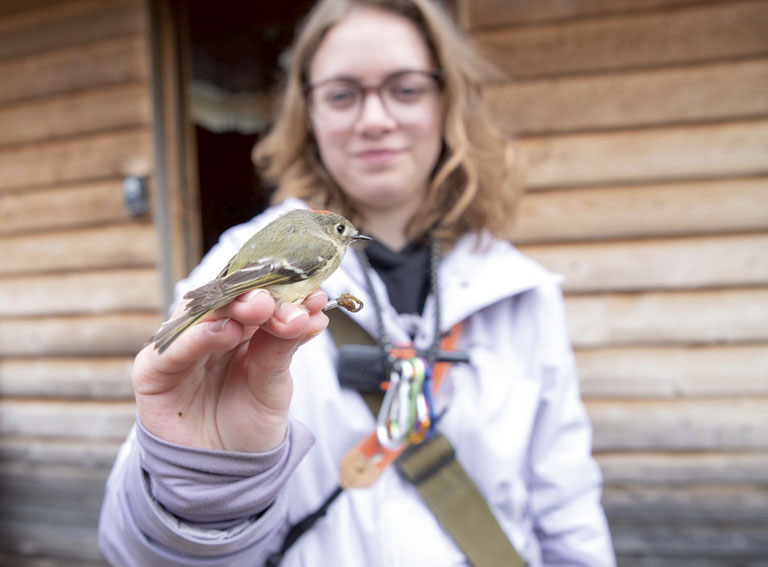
Celebrating the birds of springtime
The annual Spring Birding Festival will take place on Mother’s Day weekend with events and activities at the Prince Edward Point Bird Observatory (PEPtBO) as well as a various locations in the County. This year’s theme is “Shared skies, shared stories”. Taking place at the time of peak bird migration, the activities will include guided walks led by experts, bird-banding demonstrations, interactive presentations for kids and families, and engaging talks. The Festival kicks off on May 7 with a presentation by Elaine Anselmi, Ontario Bureau Chief of The Narwhal titled “Long Flights & Deep Dives: Environmental and Investigative Journalism” at 7 p.m. in the Picton Library Flex Space. The keynote presentation “Science of the Anishinaabek” by Joseph Pitawanakwat, Junaid Shazad Khan and Andrés Jiménez Monge takes place on May 8 at 10 a.m. at PEPtBO. There are guided walks scheduled for Friday, Saturday and Sunday where registration is required. Once again Kaleidoscope Catering will be onsite serving delicious foods and bird-friendly coffee. The full list of activities and registration and cost information can be found at peptbo.ca/sbf.
Spring bird-banding operations began at PEPtBO on April 10. Ashley Jensen, bander-in-charge, said it has been a slow start to the season in terms of their monitoring. They will not set out the mist nets in rainy weather, of which there have been quite a few days of late.
However, the migration is still in its early days, with the peak expected at the end of the month and into the first couple of weeks of May. There have been some early arrivals, typically the “black” birds such as redwinged blackbirds and brown-headed cowbirds, tree swallows, kinglets, sparrows, and the first blush of eastern phoebes. The long distance migrants from South and Central America have yet to arrive. Ms. Jensen said that the blackpoll warbler and the bobolink are among the farthest travelling migrants, with the latter making a 20,000-kilometre round trip journey.
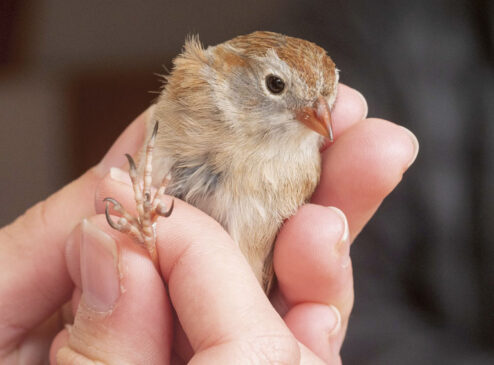 In a Times exclusive, Ms. Jensen—who is fluent is several avian languages and dialects— facilitated an interview with a longdistance migrant. Their name is not something that can be written down, but she said she could be called Maggie, and this was her second trip back north to her breeding grounds in the boreal forests. “I’ve spent the winter in the neotropical forests in Costa Rica, and grew some new flight feathers for this trip. The nets didn’t do any damage, thank you very much, but it was a bit of a surprise. And I don’t even feel this little thing that you’ve put around my leg,” she said with a touch of asperity. She said she and her partner raised a successful brood last year, her first breeding season. “It was a long flight up the first time, and choosing a mate was not an easy thing. Those boys just have one thing on their mind! Flashy feathers and even flashier songs. But I found a good one—healthy, strong and handsome. We built our nest together and then it was bam, bam, bam, one egg after another, five in total. The honeymoon ended as soon as the first one hatched. I swear they don’t stop eating! Grubs and caterpillars are the best, but they’ll take any kind of insect. It took about two weeks before they could take their first flight, and then another three weeks before they could survive on their own. We had to teach them how to find food for themselves and how to avoid predators such as hawks and owls. By the time we were done I was looking worn and bedraggled, so it was time to grow myself some new feathers and prepare for the long trip back. I can’t really tell you how I know when and where to go. It just feels right and there’s something like a built-in compass that keeps me on the right track. I’m on my way back up to the northern forests now, as soon as you let me go, back to where I hatched and where I raised my first brood.” And in two wingbeats, Maggie was gone.
The bird observatory monitors and reports on the migration and the health of the bird population in Prince Edward County. It is dependent on volunteers to carry out the majority of the tasks such as data collection, retrieving birds from the nets and ground traps, performing the daily census, and speaking to the public. To learn more about the observatory, volunteer opportunities or to make a donation, please visit peptbo.ca.
Comments (0)