
County News
Holding Court debate returns
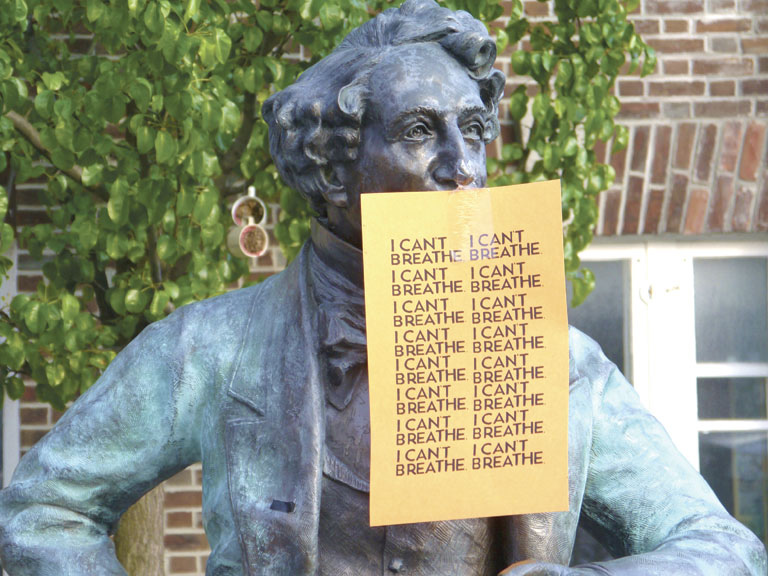
Council rejects motions as emotions—and questions—remain over public viewing future
A deeply divisive issue returned to Prince Edward County council Tuesday evening—whether a statue of Sir John A. Macdonald should once again stand on Picton’s Main Street.
The Holding Court sculpture, removed in 2021 amid public backlash following the Kamloops residential school discovery, is now the focus of a renewed push for reinstatement.
Mark Johnson, speaking on behalf of Save Our History, asked Council to direct staff to report back on the feasibility of returning the statue to its original location outside the Picton Library. His request included consultation, cost estimates, and potential plaque wording.
“The request I am making is not in any way to diminish or decrease the tragedy of residential schools,” Johnson told council. “Instead, it is about the rightful place to honour Sir John A. Macdonald.”
Johnson described the removal of Macdonald statues across Ontario and Canada between 2018 and 2021 as an emotional response— one he argued came too quickly in the wake of the Kamloops discovery.
“We believe that response was too rash for reasoned conversation and debate,” he said. “It was more reactionary rather than thoughtful.”
He suggested that, five years later, there is an opportunity to revisit the issue with more reflection and understanding.
But not all members of Council agreed that time had changed the emotional weight of the issue.
“You mention that passion cools,” said councillor Sam Grosso. “I don’t think it does. Pain doesn’t cool. Pain stays.”
It also emerged during questioning that Johnson had not yet consulted several key stakeholders, including the Picton Library Board, the artist, or the Mohawks of the Bay of Quinte.
Johnson characterized his appearance as nothing more than a preliminary step meant to initiate discussion.
“He had an emergency food program for people fleeing the American Indian Wars and he ensured that the First Nations communities were vaccinated to the same level or higher to the other communities in Canada at the time,” said MacKinnon. “If we judge the man as we should on his merits, he was an outstanding contributor.
Councillor Bill Roberts spoke at length, attempting to contextualize Macdonald’s legacy—acknowledging his role in policies that harmed Indigenous peoples, while also emphasizing his contributions to Confederation.
“When erasure and boxing-up and cancelling becomes the safest form of expression in a society, we have yet another serious problem for Liberal democracy,” Roberts said, arguing that public debate should challenge assumptions and deepen understanding.
Two separate motions aimed at moving the issue forward ultimately failed. The first, introduced by councillor Brad Nieman, would have directed staff to explore the feasibility of returning the statue to public view.
A second, amended motion that would have broadened the scope to determining the statue’s future without presuming an outcome also failed.
The result leaves Council in a familiar position with no resolution, and no clear path forward.
“We are going to have statements and questions from the public,” said councillor Phil St-Jean. “They deserve answers.”
Those questions—and strong opinions—were already evident in a packed Shire Hall gallery, where 14 speakers addressed council after the vote. The majority opposed any effort to return the statue to Main Street.
For many, the issue is not about erasing history, but about where and how it is recognized.
“Not having a statue on the Main Street doesn’t erase history,” said Christine Renaud. “It simply puts Macdonald’s story where it should be.”
“I don’t think you can excuse what has happened to Indigenous peoples,” she added. “This is about not harming people, period.”
Duarte da Silva, CEO of the Prince Edward Chamber of Commerce worried about the effects of bad press on local businesses.
“This is not a dismissal of history. It is not an argument against Sir John A Macdonald and his connection to this place, said da Silva. “From a business and reputational standpoint, the stakes are real. When a decision has the potential to damage relationships with our Indigenous and BIPOC communities, impact our businesses who are already in a precarious economic environment and generate the kind of national media attention that could cost us, it becomes a business issue.”
Others took the opposite view, arguing that removing statues risks shutting down important conversations. Author and historian James Stewart told Council that public monuments can serve as entry points for learning and discussion.
“When we put statues away, I think we are closing off our history,” Stewart said. “When we have statues out in the open, we are inviting the public to have a conversation about the history of Canada.”
Chief Administrative Officer Adam Goheen confirmed there is still an outstanding Council motion from 2021 directing staff to work toward returning the sculpture under the terms of an existing agreement—adding another layer of uncertainty to the issue.
Five years after the statue’s removal, the debate in Prince Edward County remains unresolved and deeply felt on all sides. And despite renewed calls for action, Council’s latest discussion made one thing clear, while the statue may be out of sight, the questions it raises are not going away anytime soon.
Comments (0)