
County News
If only
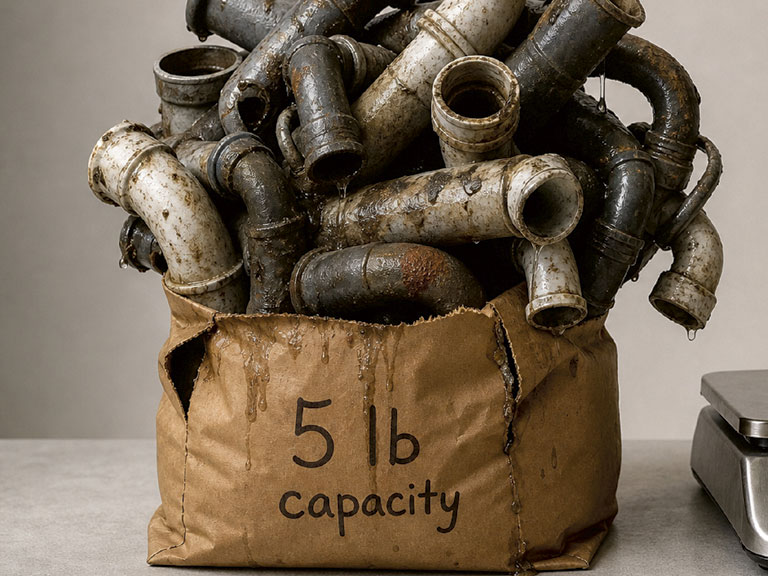
Shire Hall manages to stuff 10 pounds of pudding into a 5-pound bag
Ever since Council revised downward the County’s growth population prospects from the fantastical to merely unprecedented, its consultants have been struggling to figure out how to pay for it.
Where once Shire Hall imagined the County population would soon double, mostly through new homebuilding in Wellington and Picton, those plans were given a cold dose of reality over the past year as the market for new homebuilding has stalled out.
Chastened by the fact that it has already committed $50 million on new infrastructure in Wellington and a housing market that has dried up amid a surge of resale home listings wanting for buyers, Council earlier this year reluctantly agreed to lower its population growth target from 2.4 per cent population growth annually to one per cent.
It remains a stretch, given the County’s 150-year trajectory of flat growth in Prince Edward County. It is, nevertheless, a reasonable benchmark from which to assess the possible impacts. For planning. Not spending.
Its consultants have done the arithmetic. It will report its findings to Council on Thursday (August 27) to a committee of the whole. Unsurprisingly, the numbers remain an unworkable fantasy.
THE HIGHLIGHTS
The Grand Regional Water plan (Scenario 2B) remains the working model. But to do this will require spending $280 million. Shire Hall will have to borrow roughly $255 million of that.
It will, however, try to extract about $80 million from developers in the form of upfront financing—despite the County’s sour experience with such arrangements.
Water rates will rise. According to the report, a home paying $1,867 per year currently will pay $2,724 by 2036.
Meanwhile, development charges (DCs) will soar to $60,000 ($47,900 for waterworks DCs, $12,202 for non-waterworks growth). If implemented, they will be the highest such fees between Ottawa and the GTA. Belleville’s equivalent charges are $ 32,183 per new home; Quinte West’s DCs are $37,525.
(Two outcomes can be anticipated from such high development charges: 1. Developers won’t build in the County, and 2. Existing ratepayers will bear more infrastructure costs. A third possibility is that the province will rein in development charges across the province—leaving existing ratepayers carrying the debt load.)
To make Scenario 2B work, however, the County is counting on 171 new waterworks connections (distributed among single-family homes, multiunit buildings, and general connections) per year for the next ten years—a level of new homebuilding that has never occurred here. It will need to do so while charging among the highest municipal costs in the province.
But what happens if growth is lower than one per cent—as it has been for most of the County’s 150-year history? The report found that if population grows at just 0.4 per cent of the one per cent anticipated, the impact would push the County’s debt beyond its self-imposed limit.
The risks of Scenario 2B, however, are offset in Shire Hall’s telling that it will still have to spend $258 million to maintain separate water systems over the ten-year assessment period. Critically, the consultant doesn’t assess the reliability of the County’s input numbers; instead, it plugs them into its model.
It shows that the Regional Water Plan is roughly the same cost as keeping two separate systems. However, the consultant noted that maintaining the two systems would enable the County to gain improved financial flexibility, as the capital needs would come later in the 10-year window.
It would also give the municipality much-needed years to assess actual demand, the developers’ appetite for financing infrastructure capital costs, and to scrutinize its 20-year waterworks capital plan.
PROBLEM SOLVED?
The County’s finance department and its consultants were given an arithmetic problem. They answered the problem, but it is hard to see how it survives in the light of day. Together they have concluded that they can just about pull it off: If the County pushes its debt to the limit, if developers pay upfront and if new homes are constructed at a pace that has never occurred in Prince Edward County.
On Thursday, the County’s finance director will ask Council to adopt this plan. Then they will go out to see if the market bites. It remains a wildly optimistic and risky plan.
At some point, this council or the next will surely have to walk back its ambitions. It will direct its waterworks planning team and set real parameters about what is workable. For a decade they have been allowed to believe that anything was possible, that no dream was too big—that growth would fix all mistakes.
That isn’t true any longer. Continuing to run the same capital plan through different scenarios won’t change the input problem.
Sure. People will flock to the County to buy new homes. Because driving 45 minutes south off 401 is so much better than buying a home in, say, Brighton, or Quinte West, or Belleville, or Napanee.
Think of the peacefulness you’ll have in the new Base 31 village. Or, how about the new Kaitlin development in Wellington? Ignore the endless trucks, traffic, congestion, noise, smell, etc. And if you think the roads are bad now, just wait until all that construction and associated traffic hammers them even further into disrepair. But will the developers pay for that? They don’t even pay fully for the cost of servicing the land they’ve invested in.
The people who work in the County, by and large, struggle to live in the County. They already live in the surrounding areas, because of this. Except of course for County Staff whose salaries afford them the luxury.
Some amount of critical thinking should be applied to all of the assumptions. We can only hope that the incoming Council and Mayor will start to do this.