
County News
Heritage concerns
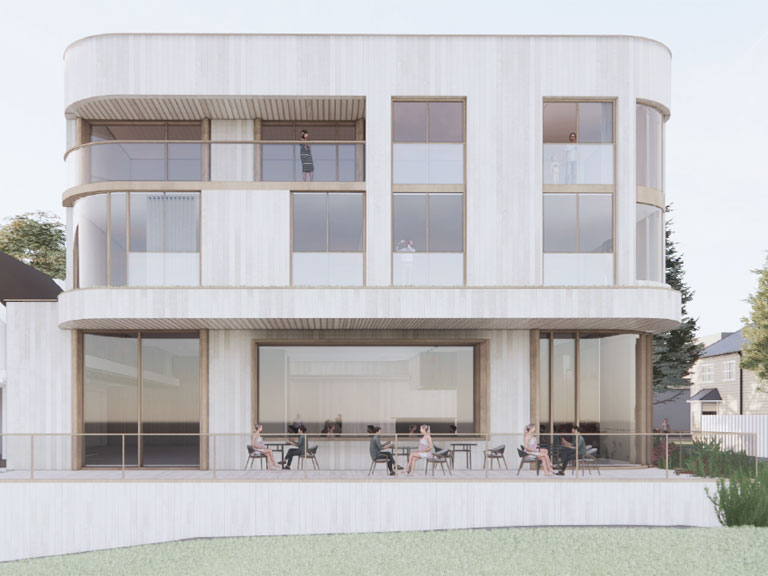
Council approves Drake Devonshire expansion despite questions about heritage process
Council has approved a heritage permit for the proposed expansion of the Drake Devonshire in Wellington, despite concerns from the County’s heritage advisory committee about the process and the scope of the project.
The application will allow the demolition of the non-contributing building at 20 Wharf Street and the pavilion at 24 Wharf Street to make way for a new three-storey hotel addition.
Earlier in August, the Built and Cultural Heritage Advisory Committee’s Heritage Permit Task Team had recommended deferring the application to allow additional work, including a peer review of the Heritage Impact Assessment. Council instead chose to refer the file back to staff, who analysed the permit and ultimately recommended approval at last Tuesday’s council meeting.
The debate at council focused as much on the heritage approval process as it did on the proposed development.
Councillor John Hirsch said he did not want to discuss the merits of the Drake proposal, but was concerned about how the application had been handled.
“We are just off to the start on the Wellington HCD,” Hirsch said. “The amazing thing is that we are being held hostage by the applicant, who is unwilling to extend the timeframe when we were given an extremely short amount of time to look at the application.”
Hirsch also said the public discussion surrounding the proposal demonstrated a lack of understanding about heritage permits and the Ontario Heritage Act.
“The dozens and dozens of emails have talked about just about everything except the heritage permit,” he said. “I fear that is because knowledge of heritage permit requirements or the Heritage Act is just not out there in the public.”
He questioned the respective roles of the heritage committee, staff and Council.
“The committee, which is charged with making a recommendation in these cases, said it wasn’t able to do that because it wanted additional work to be done,” Hirsch said. “Council turned that down and referred it to staff. We need to work with staff to see if we can get these things working properly,” he added.
Director of Development Services Cristal Laanstra said the Drake application was unusually complicated because of the number of policies and circumstances affecting the property.
She said the Wellington HCD was under appeal to the Ontario Land Tribunal during the time when the application was in process, creating uncertainty about which policies applied and what staff could require.
“That created confusion on what applied at what point in time and what staff could require,” Laanstra said.
The property had also involved two adjoining parcels with different heritage designations that were subsequently merged under common ownership.
“This brings up questions as to which policies apply,” Laanstra said. “Those are conversations that occurred that wouldn’t be typical for other properties.”
She said the application also involved different policies relating to construction and alterations.
“I don’t believe this will be common moving forward,” Laanstra said.
Laanstra said the Heritage Act requires the Heritage Advisory Committee to have an opportunity to be consulted, but does not require Council to follow the Committee’s recommendation.
“The requirements under the Heritage Act is to be given an opportunity to have an Ontario heritage advisory committee be consulted on the permit,” she said. “It doesn’t require that Council adheres to that advice.”
The legislation also gives Council 90 days to make a decision on a heritage permit. In this case, that deadline was September 11.
“If we allow deferrals, it eats up that timeline quite quickly,” Laanstra said.
Lawyer David Bronskill, representing the Drake, urged Council to make its decision rather than allow the deadline to pass.
“You do under the legislation have a 90- day window that will close on September 11,” Bronskill said. “If you do not make a decision, unfortunately, you will be deemed to have issued the permit. I think you as a council should make the decision.”
Bronskill said he did not believe further delay would be productive.
“It’s a process that I don’t think is conducive for anybody,” he said. “It is certainly not an efficient process and it is certainly not a cheap process.”
Given the positive staff report, Bronskill said he believed the permit would ultimately be issued by the Ontario Land Tribunal if Council did not approve it.
“I believe it is a process that will ultimately result in the permit being issued by the Ontario Land Tribunal,” he said.
The proposed addition is approximately 3.5 metres higher than the historic W.P. Niles House. The Wellington Heritage Conservation District Plan states that additions should generally have lesser massing and height than the existing building and should be located in the rear yard.
The proposed addition would instead be located toward the front of the property.
Staff argued that the proposal could nevertheless be supported within the broader planning and heritage framework. The property is located in Wellington’s Village Core, where buildings of up to four storeys are permitted. The design also incorporates stepbacks, curved elements and other features intended to reduce the apparent mass of the addition.
For Councillor Corey Engelsdorfer, the application highlighted the need for a clearer heritage process.
“One of the main things we need to acknowledge is that the process hasn’t always been clear,” Engelsdorfer said. “Even for me as a councillor, it hasn’t been clear.”
He said there has been confusion about the roles of council and the heritage committee, as well as the responsibilities of applicants and staff.
“We need to better educate Council, committee, applicants and the public on what the HCD is and how we all work together to make sure it conforms moving forward,” he said.
Council ultimately approved the heritage permit.
Laanstra also confirmed that meetings with stakeholders in the area are scheduled for September. Those meetings are expected to address issues surrounding site access, construction, traffic and bylaws as the project moves forward.
While the permit has now been approved, the discussion has exposed broader questions about how the County’s new heritage conservation district plans and approval processes will be applied to future developments in Wellington.
Comments (0)