
County News
Reconciling
Making sense of the numbers
How does expanding existing waterworks in Picton and Wellington to accommodate one per cent growth cost more than a brand-new intake infrastructure, a new water plant in Wellington, a 20-kilometre pipeline and a distribution system at the Picton end?
It is the conclusion presented to Council on August 27. It seems implausible. How could it be true?
The Times asked Shire Hall to reconcile the cost of the two scenarios. Their full response is posted on The Times website, but in short, it depends on what you are counting.
In fairness, there are a lot of numbers. The County engineering team produced four scenarios in June. Consultants, Watson & Associates, then took council’s chosen scenario and applied six different sensitivity overlays. The result is a dizzying compilation of numbers that can be hard to understand.
Another challenge is that the analysis starts from a given premise or scenario. That premise requires greater scrutiny.
This newspaper argues that a $360 million infrastructure project that includes a water line from Lake Ontario to Picton is exorbitantly expensive and beyond the means of the few thousand homes it would serve. It could put the municipality into a deep, dark hole. But doing nothing isn’t an option either. It means other scenarios require a closer examination.
DIGGING IN
Taking the pipeline off the table makes it important to understand how to expand and maintain separate water systems in Picton and Wellington to accommodate one per cent growth.
To do this, we have to dig into the scenarios presented in June. Scenario 2C was dismissed early in the debate. That is because the headline number suggested the cost to expand these facilities was about $224 million. Scenario 2B—the option Council eventually chose, including all the plants and pipelines—cost $216 million. Unsurprisingly, Council chose the smaller amount—all new gear—for less money. A no-brainer, right?
There wasn’t much examination in June about how this could be. Whether it made sense or not. So 2B was chosen as the best way forward. It’s how we got here.
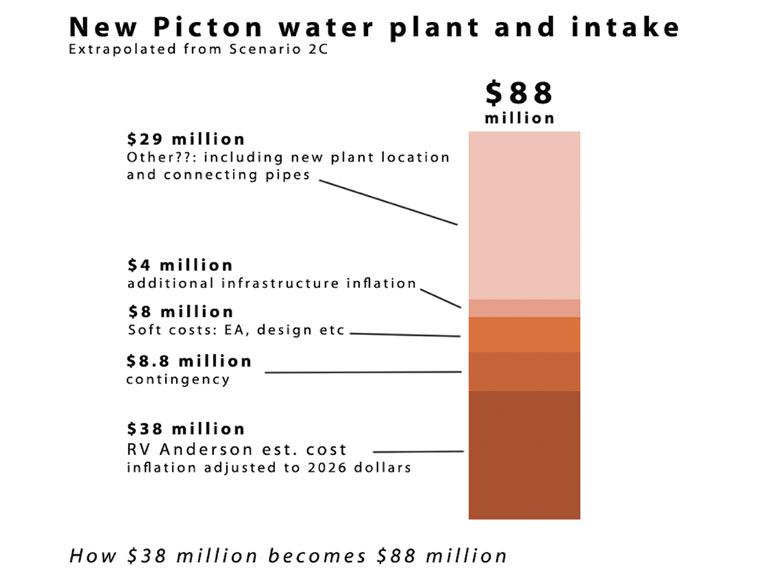
Perhaps the clearest illustration of the problem, however, is how the two scenarios calculate the cost of a new water plant in Picton. At this point, readers will have to follow some arithmetic. According to a detailed 2014 study, prepared by RV Anderson, an engineering consultancy, expanding the Picton water plant to serve for 30 more years would cost $22 million. A new intake would cost $5.5 million, for a total of $27 million.
Add 12 years of inflation and the cost rises to $38 million in 2026 dollars. County staff contend that the inflation rate for municipal infrastructure is higher than regular inflation and that the inflation-adjusted cost of the 2014 plan would be closer to $42 million. Okay.
Nevertheless, it is surprising to see in Watson’s June analysis (Attachment 10)—the analysis used to reject Scenario 2C —that the projected cost of a new intake and water plant is now $88 million total. It’s now more than double the inflation-adjusted 2014 estimate!
HOW COME?
From Shire Hall’s communications department:
“It should be noted that $42 million [the inflation- adjusted 2014 study cost] is only construction and does not include any Environmental Assessments, Detailed Design, Contract Administration, Site Inspection, Geotechnical Investigations, or Internal Staff Costs. etc. These additional costs could be in the range of $5-8 million above and beyond the construction costs, bringing the total 2026 costing for RVA’s alternative to $47.3 to 50.3 million.
“From our review of the detailed costing breakdown in RVA’s report, there also does not appear to be any construction contingencies accounted for, with a typical 20 per cent contingency on large capital projects. If this were included, it would bring RVA’s total to $55.8 – $58.8 million.”
“Shire Hall also contends that the 2014 study assumed a new plant could be constructed on the existing site.”
“It is a flawed assumption,” according to Shire Hall staff. “Neither does it consider the additional costs of a raw water pipe to an alternative location within Picton (due to limited County-owned land adjacent to Picton Bay).”
“In any event, a new Environmental Assessment (EA) will be needed. It could change the location/cost of the new intake, with the likelihood of a reduced or same cost option being unfeasible due to updated threats to the water source. This suggests the cost of a new water plant and intake in Picton, expansion of Picton’s wastewater, and expansion of Wellington’s water and wastewater plants is in the order of $84 million.”
Maybe, but this explanation is missing too many pieces. Maybe the 2014 estimates didn’t include a contingency. Why not? Maybe a new water plant can’t be built on the existing site. Why? An explanation would be helpful. Maybe the soft costs should be included. But this works both ways.
Maybe a new EA changes the location or cost of the new intake. No estimate is given of this potential requirement.
To understand competing alternatives, it is critical to first break the comparison down into like items. But even including the full value of all these maybes, it still comes up short by millions of dollars.
The cost of a new plant and intake in Picton may be more than $38 million, but there isn’t enough here to say this with any confidence. Scenario 2C requires a much closer examination.
Some may question the value of nailing down costs and comparing apples to apples. But these are big numbers. This story looks at just two of ten items in a list that totals $224 million. A small miscalculation, magnified across a spending program this large, could be enormous. As my grandfather was fond of saying, “When you look after the pennies, the dollars will look after themselves.”
Comments (0)