
County News
The long road home
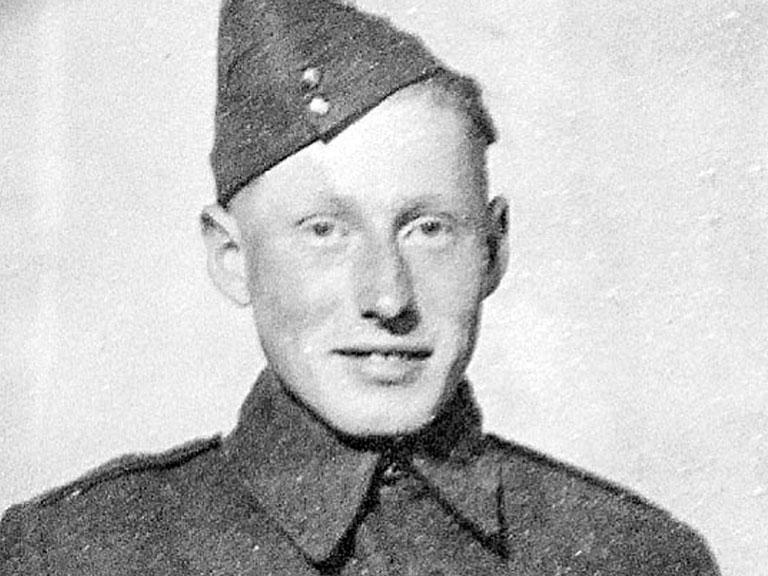
Surviving Dieppe, years of captivity and a desperate winter escape
Russ Burrows marked his 21st birthday in a prisoner-of-war camp with a candle in a piece of black bread.
Months earlier, he had landed on the beach at Dieppe with the Royal Canadian Engineers. Now, behind barbed wire, the young Canadian faced an uncertain future. Freedom was still more than two years away.
For Burrows, who later made his home in Picton, the memories remained difficult to share even seven decades later.
“I lost a lot of good buddies that day,” he told The Wellington Times in a 2013 interview. “Unless you were there, you can never understand what it was like.”
His account, preserved in that interview, offers a deeply personal connection to the history Canadians remember each November.
Born in Jacksonville, Illinois, and raised on a farm north of Oshawa, Burrows worked as a farmhand and bushman before joining the military. When war broke out, he tried repeatedly to enlist but was turned away because he lacked a trade.
The Royal Canadian Engineers finally offered him a place.
“You look like a lumberjack,” the recruiting officer told him. “We need bushmen.”
“That’s what I am,” Burrows replied.
Training took him to Petawawa and then overseas aboard the Georgic, a passenger liner converted into a troopship. In England, he learned to build pontoon bridges and hospitals, constructed tank obstacles and worked on coastal defences.
On August 19, 1942, that preparation brought him to Dieppe.
Burrows and his fellow engineers were assigned to clear a route for Allied tanks. Instead, they found themselves trapped under fire.
“We knew we were in trouble as soon as we landed,” he recalled. “Daylight was soon upon us and we were pinned down on the beach.”
He was 20 when he was captured.
The raid exacted a devastating toll. Veterans Affairs Canada records that 916 Canadians died as a result of the operation and 1,946 were taken prisoner. Burrows survived the beach, but would spend the next two years and eight months in captivity.
At home, his family endured its own ordeal. According to his account, they received word that he was missing, followed by a report that he had died. A letter from Burrows himself finally brought the news that he was alive. The local postman hurried it to the family.
Burrows was taken to a camp near Lamsdorf, now in Poland. He recalled that food and fresh water were available during the early months, with occasional Red Cross parcels bringing jam, tinned meat and other supplies.
As Germany’s position deteriorated, conditions changed.
During the winter of 1945, prisoners were forced westward through bitter cold and snow. Food was scarce. Men struggled to survive on whatever they could find.
Burrows escaped the column with an Albertan named Pat Ireland and an English prisoner he remembered only as Sussex. The three slipped away along a logging road and hid among trees until the prisoners and guards had passed.
At a farmhouse, they encountered a woman drawing water from a well.
“She just about jumped into the well when she saw us,” Burrows recalled.
She took them inside and fed them potato pancakes.
“They tasted like the sweetest cake,” he said.
The woman told them she had lost a son in the war. Her husband and two other sons were still at the front.
It was a moment of kindness amid years of captivity and destruction—a meal Burrows remembered for the rest of his life.
The men continued toward Lübeck and eventually joined another prisoner column. Red Cross parcels arrived, bringing welcome relief from hunger.
By late April, they encountered British troops. Burrows recalled being ordered, with other prisoners, to disarm their remaining German guards.
Soon afterward, a British unit arranged his return to England.
“That morning I had my first shower and shave since February,” he said.
He was back in England when victory in Europe was declared.
Returning to Canada brought another adjustment. Burrows described difficulty settling into civilian life before finding construction work in Oshawa and later a job at General Motors, where he spent much of his working life. He raised six children.
In Picton, he became a life member of Royal Canadian Legion Branch 78. In 2012, he returned to Dieppe as the Royal Canadian Engineers’ representative on a Legion Pilgrimage of Remembrance. Seventy years after his capture, he stood again on the coast where so many comrades had been lost.
Burrows died at home on May 5, 2014. His funeral was held at the Picton Legion.
His story leaves the County with more than a record of battle. It preserves a young man’s birthday behind wire, a family’s relief at receiving a letter and the remembered sweetness of food offered by a stranger.
Behind the history of Dieppe was a man who survived, came home and built a life—while carrying the memory of those who could not.
Comments (0)