
County News
Bird flu at Wellington Harbour
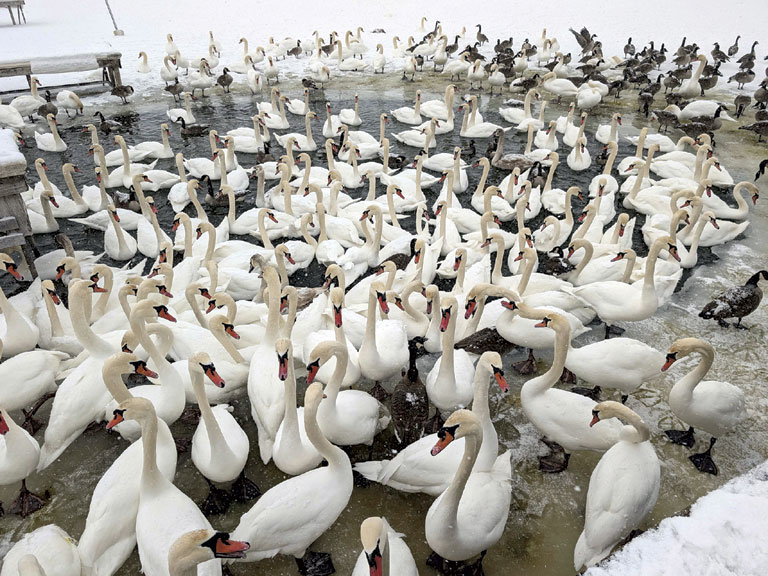
Fears rise of an outbreak among wild bird population
Last week, a sick Canada goose from Wellington harbour was taken to the Sandy Pines Wildlife Centre where it was subsequently diagnosed with Highly Pathogenic Avian Influenza (HPAI) H5N1 and put down. As the harbour area is crowded with waterfowl (swans, geese and ducks) in the small area that is still ice-free, there are fears that the highly contagious virus could spread quickly through the population. As of this past weekend, there were a number of dead birds on the ice, and some of them have been scavenged by birds such as eagles, hawks, crows and seagulls, leading to the prospect that the disease could spread beyond the water bird population.
The H5N1 virus can persist in the environment for a long period of time and is spread through bird secretion or feces. Infected birds could show signs of distress, low energy and uncoordinated movements. Human infections with avian influenza are rare and almost always acquired through close contact with an infected bird. However, humans in contact with infected wild birds could carry the virus on their clothing and possibly then spread it to domestic birds. Many of the swans and geese in the Wellington harbour venture onto the dock and leave their feces there, so visitors who come to feed the birds should take precautions to avoid inadvertently spreading the disease.
Naturalist Terry Sprague said that nothing can really be done about the spread of the disease among the wild bird population, and it will run its course. “The fallout is that birds of prey and carrion eaters such as vultures, eagles, hawks, crows, ravens and gulls are highly susceptible when they feed on the carcasses,” he added in an email. The Canadian Wildlife Health Cooperative does keep track of HPAI infections across the country, with reports of instances from organizations such as Sandy Pines or the public. In December, 2025, two carcasses of red-tailed hawks found near Picton were confirmed to have the HPAI virus.
It is possible that some of the dead birds on the ice in Wellington harbour succumbed to starvation or to the extreme cold, but the possibility remains that they died as a result of the avian flu virus. Hawks, eagles, crows and gulls have been observed feeding on the remains, raising fears that the disease could spread beyond the waterfowl population.
If it reduces the non native population of Mute Swans that are destroying our waters I am ok. It will provide our native ducks, geese, terns, loons nesting areas to survive.