
County News
Brothers Twells
Story of murder resurfaces in Wellington Cemetery
The boys had dreamed of drifting along the waves of Weller’s Bay. They’d spent long winter nights poring over magazines of sailing ships, rowboats and runabouts. Their father, Charles Twells, had promised to buy the boys a 25- footer in the spring. Spring never came.
On a cold January night, early in 1929, Charles shot his sons with a .32 calibre revolver. They died in separate rooms. Their mother, Edith, escaped to tell their story.
THE BEGINNING
Edith and Charles grew up in Shropshire, England. They met, married, and were soon blessed with two boys, Kenneth and Colin. Charlie, as he was known, trained and practised as a physician—though hints of the madness that would overtake the good doctor had already been observed while still in England. The couple lived in the market town of Wellington, half an hour west of Birmingham. Life was difficult in 1920s England. Poverty was pervasive, sanitation poor, and disease rampant. Dr. Twells had contracted tuberculosis, likely in his practice.
Edith’s brother Arthur Corfield had emigrated to Canada in 1923 and settled in Consecon. He urged his sister and family to join them in Ameliasburgh. So in 1925, the Twells family made the journey across the Atlantic, arriving in Prince Edward County. They settled on a 150- acre farm on the south shore of Weller’s Bay, west of the hamlet of Consecon.
Charlie was attracted by the idea of a fresh start, of clean air and better economic prospects for his sons. But Charlie wasn’t a farmer. He made a sharecropping arrangement with his brother-in-law. Arthur would manage the farm in return for a third share of the profits each year.
The arrangement worked for a few years. But by 1928, economic storm clouds were forming around the world. Dr. Twells had made some bad investments, and so when December rolled around and it was time to settle accounts with Arthur, Charlie didn’t have the money to pay him.
Arthur pressed Charlie for what he was owed. The argument escalated quickly. Arthur’s fury boiled over. Charlie calmly ordered his wife’s brother to get off his land.
Arthur spoke to a Belleville lawyer who recommended he try to patch things up with Charlie. Two days into the new year, Arthur knocked on Charlie’s door. It was about 5:30. The dinner dishes had been cleared away. Edith was washing up in the scullery adjacent to the kitchen. Charlie was sipping tea at the dinner table.
Arthur demanded payment. But when Charlie refused to respond, Arthur’s voice and mannerisms became more volatile. Arthur was angry and wanted Charlie to know it. Charlie remained calm. Detached. “Nonchalant’ was the term used later in trial transcripts.
Dr. Twells explained that the farm’s books had been tallied that day and that with his investment losses, he had nothing with which to pay Arthur.
Then, without notice, Charlie suddenly pulled out a revolver from his coat pocket and shot Arthur in the face. The Webley .32 calibre revolver pistol was designed as a “pocket” gun. The shell pierced Arthur’s cheek and shattered when it hit his cheekbone— fragments ripping apart his hearing canal.
Arthur staggered out of the house badly wounded. He heard six more shots from inside the house.
Inside, Charlie now trained the pistol at his oldest son and fired, killing the boy instantly. Charlie chased Colin into another room. It took several more shots before Colin lay still. Charlie then picked up the dead boy and laid him tidily beside his brother.
Charlie settled into his chair next to the boys.
This was the scene upon which Edith found her boys. She managed to pull the gun away from Charlie before running across the road for help. She passed by her brother, wounded and unable to start his car. The police and ambulance were called, but none of the neighbours were willing to return to the house with Charlie still there.
Edith went back into the house. Charlie had not moved. He was still sitting quietly in his chair.
“It’s alright,” he said. “I shan’t do anything.”
Why? Why?” sobbed Edith, according to court records of the inquest.
“Everything will be alright,” said Charlie.
Police found another loaded revolver on the doctor before taking him away, peacefully.
AFTERMATH
An inquest was gavelled to order 12 days later in the Masonic Hall in Consecon. The panel quickly determined that Dr. Twells had murdered his two sons and had intended to murder Arthur Corfield. A trial was set for November in Picton, where Charlie was determined to be criminally insane.
On January 2, 1930—one year after his heinous crimes—Charlie was committed to the Asylum for the Insane at Penetanguishene for the remainder of his days. He died there twelve years later. He was buried on the grounds of the Asylum in an unmarked grave.
After the trial, Edith returned to Shropshire and married a widowed policeman with two children from a previous marriage. Edith and her new family eventually moved back and settled in Ameliasburgh. She died in 1967 at the age of 70.
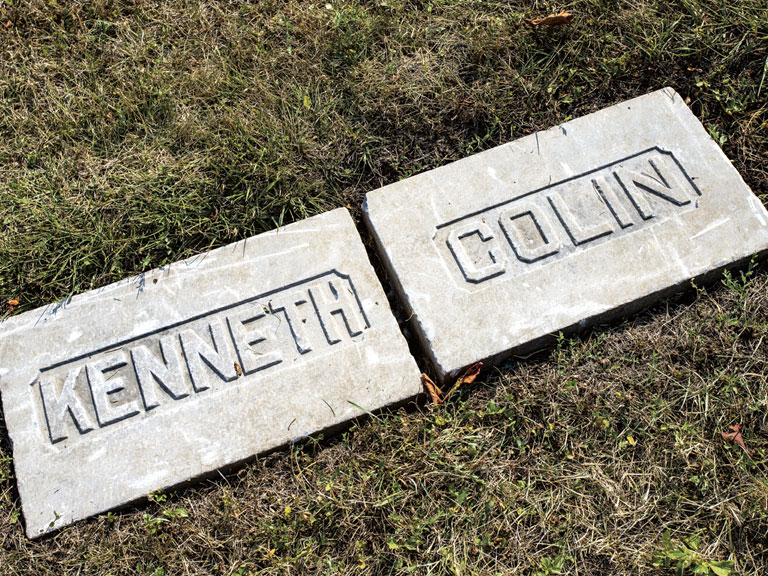
Kenneth (10) and Colin (11) were laid to rest on January 4, 1929. They are buried together in a single lot in the Wellington cemetery.
Dreams of two young boys sailing in the summer breeze on Weller’s Bay were erased in a moment of madness. By the hand of the person they would have trusted most in the world.
EPILOGUE
Arthur Corfield survived the attack and lived another 65 years in Ameliasburgh. He is buried in Mount Grove Cemetery in the village.
Vic Alyea had heard the story of the two boys and wanted to know more. With the invaluable assistance of County Archivist Krista Richardson, he began digging up records, trial accounts and newspaper reports.
But Alyea couldn’t find the grave markings for Kenneth and Colin, even though he knew they were buried in the Wellington Cemetery. Tod Lavender of Ainsworth Funeral dug up details about the location of their burial
Alyea used this information to poke and prod the earth until he hit stone. Six inches below the grass, he uncovered the markers labelled simply Kenneth and Colin. Their markers, and their story, have been restored to the surface.
Comments (0)