
County News
Building blocks
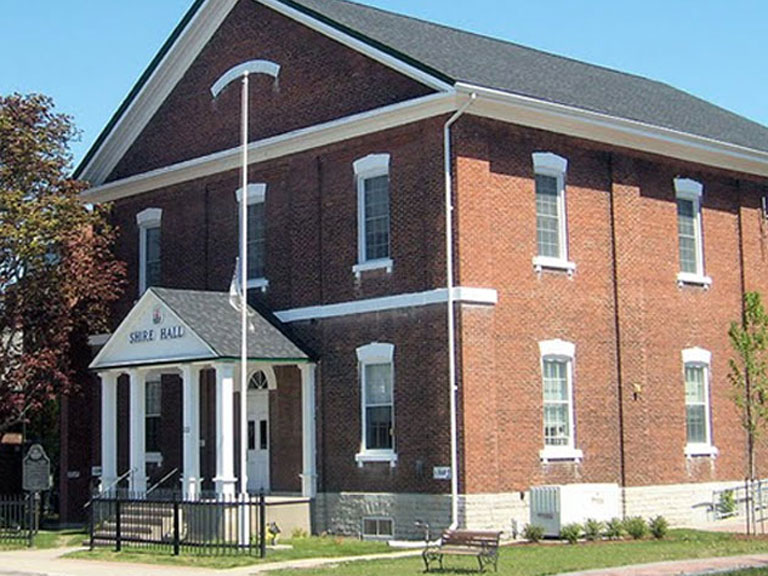
Shire Hall’s new leadership charting a different waterworks path
Bit by bit. Rationally, coherently, transparently, a new leadership team is working to restore credibility in Shire Hall.
“I have had more clarity in this meeting than I’ve had in three years on council,” said Hillier councillor Chris Braney during a committee of council session last week. “It gives me confidence and hope that we are going to find durable solutions.”
The issue before them was waterworks—a thorny, tangled subject that has plagued Shire Hall decision-making the entire term of council.
Grand expansion schemes based on a doubling of the County’s population were always a wildly risky gamble. Now these heady notions have come back to earth. The days when anything was possible and no municipal adventure was too dangerous appear to be over. The era of inflicting ever-greater, forever risk upon taxpayers and water bill payers seems to have run its course.
Wishful thinking has been replaced by sober step-by-step planning—constructed upon hard facts and things that can be measured, validated and relied upon. If developers don’t do what they said they would do, there are remedies for that, too.
EV800
A couple of weeks ago, Shire Hall took another look at EV800. It is perhaps the most important planning policy tool. The policy sets the terms by which developers are allocated waterworks capacity in its plants. The new rules establish a higher threshold for attaining the precious allocation in the first place and impose time limits to ensure that expensive new infrastructure doesn’t sit idle—the ‘use it or lose it’ principle.
Former leadership learned a hard lesson in Wellington, where a developer acquired the remaining capacity in the village plants yet continues to sit on his plans. The developer hasn’t built a home in Wellington, and isn’t expected to do so in the foreseeable future. In the meantime, no other homes may be built until the developer is ready.
Shire Hall’s new leadership won’t make this mistake again.
BASELINE
Step two arrived last week. The report presented to Council offered a baseline analysis of the real capacity remaining in the four plants in Picton and Wellington (two water and two wastewater treatment plants). The results were informative, and challenged the perceptions of some council members.
The good news is that there is room for growth in Picton, even after deducting the capacity (700 units) that has been committed to developers so far. In Wellington, however, the system has just five units available—beyond the idle portion (483 units) it has committed to Kaitlin.
That there was surplus capacity in Picton came as a surprise to some council members. What followed was a discussion about the proper definition of the word “imminent”. Previous leadership had used a more liberal interpretation of the word, suggesting that as many as 4,000 new housing units were “imminent”.
The current leadership explained that their definition includes only housing projects that meet the EV800 criteria—that is, that they are very near site plan approval, have a subdivision agreement, and have submitted the securities required by Shire Hall.
In Picton, this reduces the number down from 4,000 to about 700 units: Base31 has about 380 units (260 in Village A, 120 in an apartment building), Nicholas Street apartment project with 100 units, Wellings project with 50 units and Cold Creek with 185 units. It is a meaningful runway of potential development.
The implications are profound when planning for the next steps in waterworks expansion. Mostly, it means Shire Hall may now slow down and prepare with a clear head. There is no urgency.
Councillor John Hirsch had difficulty reconciling the messages from previous leadership.
“Doesn’t the province expect us to look out at least 15 years?” asked Hirsch. “I know that in 15 years, we are looking at a lot more than 700 units.”
CAO Goheen explained that his numbers are based on direct signals from developers.
“The total plan for Cold Creek is for 900 units,” acknowledged Goheen. “But that’s not what they are asking for. Cold Creek phase one is about 185 units—that is what they are requesting to move forward.
“There are multiple reasons why developers parcel into phases. A lot has to do with securities, the cost of construction of the infrastructure,” explained the CAO. “This is their market, their analysis, their ask. It gives us a bit of a feel of the market in Prince Edward County.”
Cristal Laanstra now heads development services at Shire Hall. She noted that the 700 units that may soon qualify for committed waterworks capacity are likely to spend five years or longer in production. Laanstra suggested the County has the development runway that the province has prescribed.
“It might be that we have the capacity to sustain the development that we are looking at,” said Laanstra.
A NEW APPROACH
Yet some council members wanted to jump to the next step, eager to push the button on new plants and new pipes. It took a while for some to absorb the message that the days of rushing ahead without a road map and without a financial plan were over.
Instead, Chief Administrative Officer Adam Goheen guided Council back to the slow and steady track.
“The what and when are the next conversation,” said Goheen, likely to come in October.
For now Council needed to understand that Shire Hall’s new leadership had erected sturdy fencing (EV800) to protect the County’s valuable infrastructure, and it was presenting a sober assessment of its current waterworks capacity. It was providing a baseline from which the next discussions would occur.
There were several clues suggesting its approach is very different than the previous leadership outlook.
Decisions about moving forward will be based on growth prospects determined by experts and historical experience, not theoretical maximums. Hardball conversations with developers will determine real needs in the near to medium term. Infrastructure expansion decisions will be informed by rigorous plans that ensure growth pays for growth—and that existing residents don’t bear this risk and cost.
“Given that we have new people in key positions, we are doing our homework,” said Goheen. “We are familiarizing ourselves with the various water and wastewater plans, studies and reports in preparation of re-engaging with Council and the public and continuing the conversation around our major infrastructure planning. We need this to support our current population and future growth.”
Comments (0)