
County News
County Studio Tour
County artists welcome visitors to their studios
Anear-perfect late summer weekend brought hundreds to visitors to artists’ studios across the County during the annual PEC Studio Tour. From Carrying Place across to Northport and down to Long Point there were 39 participating studios and 62 artists showing paintings, mixed media, fibre arts, ceramics and sculptural works. Finding a route to the various studios was made easier this year with the Toureka phone app, where visitors could make a selection of studios and have the route mapped out. The tour allows visitors to meet with artists in the place where the artworks are created, to learn about the creative process behind the pieces, and to shop for art. Since its inception in 1993, over 350 artists have taken part in the tour and there have been thousands of artworks sold.
Painter Kate Sorbara invited three guest artists to join her in her studio in Northport. One of the guests was Tassie Notar, who started painting 10 years ago after she retired from her job as a CBC current affairs producer and moved to the County. “I had no time for painting when I was working, but always at the back of my mind it’s what I wanted to do,” she said. She was inspired by the landscapes of the County, and she converted the guest bedroom in her house for use as a studio. Over the years she has taken art courses at the Baxter Arts Centre (from former Cherry Valley artist Kato Wake), Haliburton School of the Arts and the McMichael Gallery. This is her third year on the tour, and she has exhibited her work at Art in the County as well as at a gallery in Toronto. She paints landscapes and abstract landscapes in acrylics based on photographs, and recently she has begun painting abstracts based on floor tiles inspired by their intriguing patterns. She is constantly seeking to improve her skill and learn new techniques, and said that she enjoys taking part in the Studio Tour. “This tour is a great way to provide a focus for me. The visitors are so kind and they say nice things about my work, and that really spurs me on.”
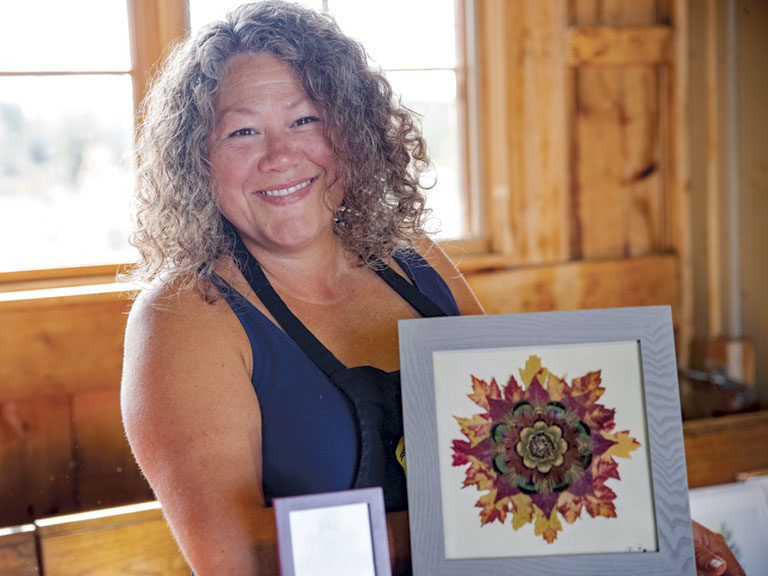
Tyendinaga feathersmith Rebecca Maracle was another of Ms. Sorbara’s guests. Ms. Maracle is a traditional medicine healer and a member of Bear Clan. She is a fourth-generation artist, and says she has been making art since she was old enough to be able to put a bead on a string. She learned different art styles and techniques from her grandparents, parents and uncles, and she studied photographs of her great-grandfather in his regalia as a medicine man to incorporate those patterns and styles in her own artwork. At age 20 she started working with feathers and she has created her own style of kaleidoscopic artwork. “I put teachings and gratitude for the natural world in every piece I make. As I create my artwork, I am putting in the message of paying light, love and medicine forward,” she said. “I incorporate all of the medicine part of who I am and the line of women that I come from into the designs that I make.”
She initially started making jewellery pieces from feather and hide, and she now make framed pieces of art using feathers. She has an intimate knowledge of the different types of feathers, and she will often create her artworks piece by piece towards a final image. Sometimes, however, a total image will reveal itself in her mind. “I see an image that comes to me not by my own thought, but by spirit. And when these come, I know that I am meant to create it for somebody specific and I follow where I am guided. It’s really interesting to see how long I hold onto the piece before the person comes who it is meant for. To see somebody connect with a piece of art where it draws that emotion, then I know I’ve done my job. This is a deeply spiritual practise. I encapsulate that and put it into everything I do.”
Viktoria Brave is a young textile artist and this was their first time on the studio tour. They are a trained woodworker, and worked in that field for a few years before deciding to pursue a career in academia, studying for a PhD in relational philosophy. “In that process I noticed they were using textile and weaving-related terms to talk about the entanglement of all beings, so I decided to start weaving as a way to understand entanglements better. I fell in love with it. It’s a really interesting mix of analytics and colour theory, and it’s also a part of my heritage as a Quebecoise. When I wanted to do more images, I turned to quilting and it was love at first stitch. Now it feels like I’m constructing with colours, and that is so joyful,” they said. They started weaving just four years ago, and began quilting the following year. They love the complexity of quilting and the ability it gives them to express concepts such as care for the environment, resilience and rebirth. “Quilting is a very emergent process. It’s very time-consuming. It’s about putting colour together so they get to resonate and shine. That is what I love the most about it. When I turned to quilting, it was at a moment in my life when I needed a lot of healing, and this practise brought me back fully alive.” Mx. Brave had a solo exhibit called Emergence at the County Arts Lab in July and is the chairperson for the 2026 Quilt Show in the County. To see more of their work, please visit viktoriabrave.com.
Jamie Janx Johnston’s studio is located at the end of Morrison Point Road, and the exterior is covered in examples of his work. He is a street and mural artist, and was the production manager of the Montreal Mural Festival for the past 10 years. Drivers along Old Milford Road, just outside the village, will have seen his osprey mural. He creates street-art-like works of birds and animals based on photographs he’s taken. There’s a billboard and graffiti- like quality to his artworks, drawing from his experience as well as from a phase in his early life where he was an adept user of spray paints. He has been a fulltime resident of the County only since July, but he has been a regular visitor since the days when Cherry Valley had a reptile museum, which his zoologist father would often visit. The photographs of the animals and birds used for his artworks were all taken at research or rescue centres, and Mr. Johnston’s paintings all incorporate the direct and frank stare. “I feel like that’s an important impact point. I try to do it so that it frames out the face, so it kind of sticks out a little bit more and gives that layering to bring a three-dimensional look even though it’s a two-dimensional painting,” he said. This is his second year on the studio tour and he said he is impressed by the number and the variety of artists who take part.
Comments (0)