
County News
Demolition
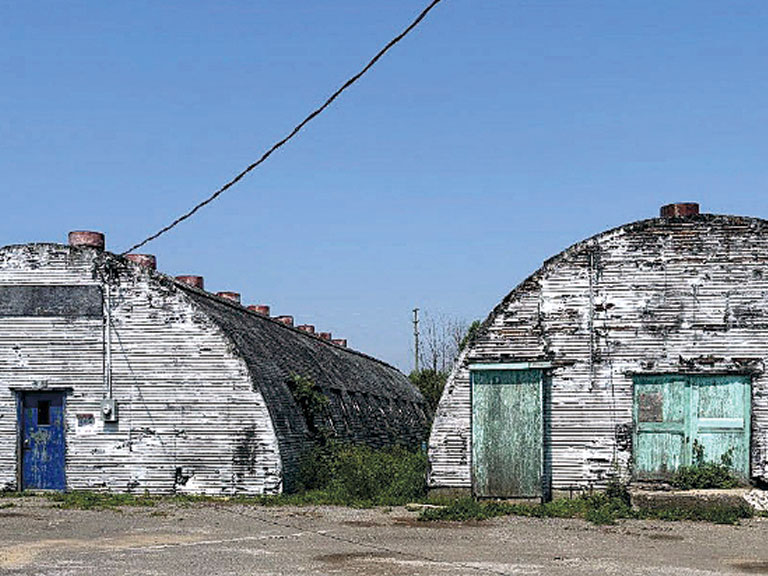
Base31 seeks to tear down two military quonset huts from the 1950s
The Built and Cultural Heritage Committee discussed a notice of intent to demolish two quonset huts located at Base31 last Wednesday.
PEC Community Partners have provided the County with a formal notice of their intention to demolish two listed buildings on the Base31 site—buildings 53 and 54.
“PEC Community Partners Inc. has been the owner of the property since 2021 and has been working diligently to properly maintain, renovated and make safe the existing structures on site, while also working on an Area Concept Plan to bring a wide variety of housing and community resources to the community,” said a letter from Kathryn Randle of Rockport Group. “Many of the existing structures are in poor shape and contain numerous hazardous substances. The purpose of the demolition is to bring forward an information centre and new home sales and leasing at building 28, next to 53 and 54.”
According to Randle, the two quonset huts exhibit indicators of lack of historical maintenance and care. In order to better assess the current condition of the buildings, Gerrits Engineering Limited, reviewed them and concluded the observed extent of deterioration and repair work required to restore structural integrity would be significant.
“The cost to remediate may exceed the cost of replacing the buildings. Renovation and repair would also require dealing with the substances identified in the Designated Substance Report adding significant costs,” she added.
Steve Willis of Stantec Consulting gave the committee some background of the intent to demolish. He noted that the Base31 site is a listed but not designated property.
“Last year, when the Area Concept Plan for the redevelopment was adopted by council through an Official Plan Amendment, there was a Heritage Assessment of the site that identified contributing and non-contributing buildings on the site. The two buildings referenced in the request are considered non-contributing buildings,” said Willis. “There is a plan for the redevelopment and these were not identified as those to be saved. There are other buildings that will be saved.”
Willis also noted that as part of the subdivision approval process, staff are working on a Memorandum of Understanding (MOU) about the care taking of the retained buildings.
“Basically, we are trying to ensure that there is a program for ensuring that thoughtful decisions are being made about retaining the heritage character of the buildings, if there are any adaptations that come forward,” said Willis, who added that County staff will have the ability to review and provide comments.
Committee member Bob Waldon asked about the decision to use an MOU as opposed to site plan approval, or conditions of approval, in the sub-division agreement.
“The MOU is really meant to deal with these situations, like the one you have before you today, where there is no clear process,” said Willis. “We wanted to lay out what happens if there is an adaptation, or alteration. It doesn’t take away the opportunity for the County to put additional conditions where planning applications are there.”
Committee member Edwin Rowse said he was alarmed that the discussion about the quonset huts was so wholesale, and dismissive of any sort of significance they might have.
“I found that a little lacking in heritage perspective,” said Rowse.
Willis noted that it all relates back to the Cultural Heritage Assessment from February of 2024, which is part of the Master Concept Plan process.
“It talked about contributing and non-contributing buildings, which is a normal way of characterizing districts. This is not a heritage district. They were built later than the rest, and were not part of the original formation of the Base as I understand it,” said Willis.
Rowse asked where the 1950s date mentioned in the letter came from.
“We as a committee are also professionals. We also understand about these issues. I am a heritage professional with 40 years experience. I don’t just take those things at face value. Where is this 1950s date described?” asked Rowse.
Kathryn Randle noted that it was the information received from the Base31 consultant.
“We can try and provide further information,” said Randle. “We also heard a very similar date from the previous owner.”
“Just the fact that if they were from the 1950s, they are still representative of a very typical military installation. We currently do not fix things by a restoration date, but by the contributions over time of the assets to the site,” said Rowse. “I am even questioning the evaluation not necessarily of contributing or non-contributing, but of their own value, and how this is going to be commemorated or documented. There is no information about this, it is just we want to demolish.”
Willis said that in the situation where buildings are only listed and not designated, the County does not have regulatory authority, other than the intent to demolish.
“We are trying, in good faith with the applicant based on the heritage evaluation that was done last year, to negotiate a process with them. If documentation is an important matter, that is something we can take up with the applicant. We are focussed on the contributing buildings more than the noncontributing buildings,” he said.
It was still not good enough for Rowse.
“We are not getting a third party objective evaluation directly from yourself as a consultant. I think you’ll agree. Quonset huts are rare. They are structurally innovative for their time. They have tremendous historical associative value with military installations in Canada. Is there not a place for a small commemoration of all of this?” he asked
Randle said that her group was looking at the site holistically.
“We have put up a new quonset hut because we do recognize the value of that built form and the character that it did play for the era of the site,” she said. “These two quonset huts in particular are structurally not sound. They have a whole bunch of contaminated substances on them that we are going to have to deal with. So these two buildings in their current state, we don’t feel are appropriate to restore.”
In a separate letter, sent be Randle, she also said the buildings weren’t worth saving.
“In our opinion, the buildings do not exhibit design value, physical value, historical value or contextual value,” stated Randle. “The buildings, being quonset huts, are not rare, do not display high craftsmanship or technical achievement. These buildings are not out of the ordinary, nor are they hard to come by.”
Rowse then noted that given the current climate of heritage that has been created by the current government, he would like to see some components saved.
“Say they’ve got seven or eight windows long, and if we kept three windows, and we moved one small part, cannibalized the others, to create materials for repair, could we have a commemoration which would involve a small remnant of at least one of the two huts?” he asked.
Willis said he was being very respectful of the requests put forward by the committee.
“The Master Concept Plan was adopted by Council, and it has now been embedded through a Ministerial Zoning Order as well which was just issued this past month. That plan talks about the buildings to be retained and the buildings that are non-contributing. So if I could take from this committee some recommendations on things to discuss in the MOU, outside of the issue before you today. What you have before you today is an actual notice that council will have to address. I am willing to take back some advice from this committee like commemoration on the property for buildings removed.
Sandra Latchford, Chair of the committee, reminded the group that the item was for discussion only and no decision would be made. Council will ultimately have to make a decision on the Notice of Intent to demolish.
Comments (0)