
County News
Flashback February
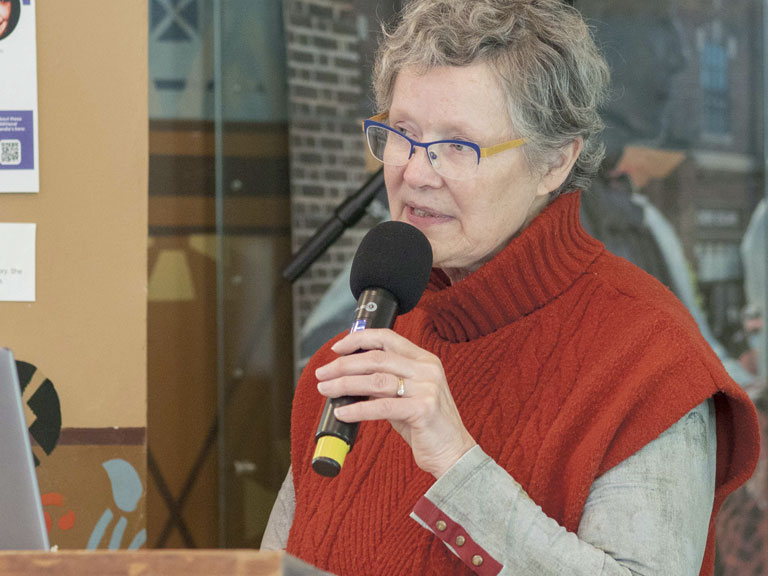
Delhi: the continuing evolution of Picton’s oldest neighbourhood
It was a full house at Macaulay Museum for the Flashback February presentation of “Delhi: Then and Now” that traced the evolution of Picton’s oldest neighbourhood from the beginning of the nineteenth century to present times. This event was sponsored by the Picton BIA and was presented by the PEC Heritage Conservancy, the Friends of Delhi Park, and the Department of Illumination and the Aurora Borealis Choir, with proceeds from ticket sales going to the project to digitize the Historical Architectural Survey of Prince Edward (HASPE) collection at the Wellington Archives. Liz Driver, president of the Prince Edward County Heritage Conservancy, opened the presentation with an explanation of the name “Delhi” for this neighbourhood. The earliest reference to the name comes from a letter by William Macaulay on December 31, 1835. Ms. Driver said the name may have originated as nickname for the harbour area where a large number of Indigenous men worked as stevedores, stokers or sailors, and were housed in tenements. As these men were then known as “Indians”, the reference was to the city in India. However, Ms. Driver speculates that the area may have been named by Loyalist settlers after a town in New York, as the pronunciation is the same. The area was initially developed by William Macaulay and his older brother, John, starting in the early 1820s. A meeting house (church) was built in 1821, followed by a cottage in 1825—which still remains. Macaulay House was built in 1830, and the Curate’s House was constructed in 1835. The latter now has siding covering the original stone building. Around this time William Macaulay had a “master plan” for this area, and there are drawings showing lot boundaries and the road layout. Interestingly, the last lot in this plan was sold in the early 1900s. As part of William Macaulay’s vision, marshes were drained and waterways rerouted, considerably changing the look of the landscape.
Over the following decades, an array of imposing buildings was built in this area. Some have since been demolished, but many still survive, giving Picton its unique character.
The area that is now known as Delhi Park was the town dump, and was an unsightly mess that separated Delhi from the rest of Picton. Dump fires were not an uncommon occurrence. The dump was finally closed in 1980. A thin layer of topsoil covers the detritus of decades. Ms. Driver said that Macaulay’s master plan is still being seen in current developments along Nicholas and Cumberland Streets.
Following Ms. Driver’s recap of the history of the Delhi neighbourhood, Victoria Taylor then spoke about plans to revitalize Delhi Park. This will involve the creation of accessible walkways that will improve access to the park. The first phase of the project is the creation of a path between Macaulay Heights and downtown Picton. This would allow residents of the Heights a safe and accessible walkway to the town. While there are now community gardens established in the park, it remains underutilized due to the lack of amenities. Last year, the Department of Illumination launched the Delhi Park Project, with the aim of bringing more people into the park. There were art sessions, natural history lessons and a weekly community meal. The project culminated in the Delhi Park Pageant, a festival of song and dance. To close Saturday’s presentation, the Aurora Borealis Choir sang two songs composed for the pageant.
Flashback February events continue today (Wednesday) with a presentation by Jeff Young at Macaulay Museum about the development of the AVRO Arrow test models. On Thursday at 2 p.m., there will be a community hymn sing at St. Mary Magdalene Church featuring the 1914 Cassavant organ. On Friday, the Picton Gazette is sponsoring an evening of readings at Base31 from stories chronicled in that paper in the 1940s. Flashback February ends on Sunday with the County Jam at the Waring House, where a line-up of local musicians will provide an evening of music.
Comments (0)