
County News
From foundry to future

The layered history of 24 Wharf Street
It began with a wharf. From timber, piers and planks sprang industry, development and growth in the rough early days of Wellington. Last week, before a packed audience, Ernie Margetson told the story of 24 Wharf Street—its origins, its story and its role in shaping the village.
The event was sponsored by the Wellington Community Association and hosted by the Drake Devonshire, the current occupants of the historic property. Margetson is a lifelong resident of Prince Edward County and an engineer by profession. He served a term as a municipal council member representing Hillier. And Margetson is surely the leading expert in local architectural heritage, particularly the work of W.F. Fitzgerald, a builder whose distinct design signature is sprinkled throughout the village, including 24 Wharf Street.
“My talk was about the people involved with this—not only this building, but this property—and a little bit of a history of where we are, where we came from, and how we got to this right now,” explained Margetson after his presentation.
THE WHARF THAT BUILT WELLINGTON
Long before the current structures at the foot of Wharf Street in Wellington took shape, the property was defined by the wharf that extended into Lake Ontario.
In the 1830s, Archibald McFaul understood that for this community to grow, there had to be a reliable way to get goods and people in and out of Wellington. It was a bold and risky venture. But it proved a huge success.
It became one of the busiest ports on Lake Ontario— one of the most dangerous—but one of the busiest,” Margetson told the audience.
Before the railway arrived in 1879, water transport was everything, according to Margetson.
“We relied almost entirely on wind power at that time. Wind on the water, horse on the land. That was our transportation.”
From the Wellington wharf, schooners loaded with wheat, barley, rye and thousands of barrels of whitefish headed out to markets in the United States. They returned with brick, coal and iron, materials that quite literally built the next phase of the village.
Farmers lined up along Wharf Street to the town limits with wagons loaded with grain bound for market. A massive 120-foot-long storehouse was erected beside the wharf to ease congestion and facilitate the growing goods traffic.
Fishing was also an important economic driver. In 1838, William Henry Bartlett stopped in Wellington and created one of his 117 detailed sketches of Canada, providing a rare glimpse of pre-1850 life.
“This sketch is special because it shows how important fishing was to Wellington,” said Margetson. “You can even see the wharf and the tree structures they used. Bartlett captured real life, maybe with a touch of artistic flair.”
Despite the wharf’s critical importance, its exposure to powerful winds and storms off the lake made it vulnerable— a hazard to boats tied up during these storms or to those seeking shelter. Captains knew they were taking a chance approaching it. But Wellington’s location made it worth the risk.
“Being in Wellington, even though it was exposed, was a big advantage in exporting to Oswego,” he noted.
Storms regularly damaged the structure, and it had to be rebuilt more than once. Lake levels fluctuated dramatically in the 19th century, long before modern regulation dams, adding another layer of uncertainty.
Even after the railway reduced the port’s dominance, the storehouse remained in use for decades, serving as a transfer point for goods arriving by train before it was dismantled and repurposed elsewhere in the village.
Today, little remains visible of the actual wharf itself. But beneath the modern inn and surrounding properties lies the footprint of the infrastructure that first made Wellington thrive.
INSIDE THE 1864 FOUNDRY
If the wharf was Wellington’s gateway to the outside world, the foundry at 24 Wharf Street was its industrial engine.
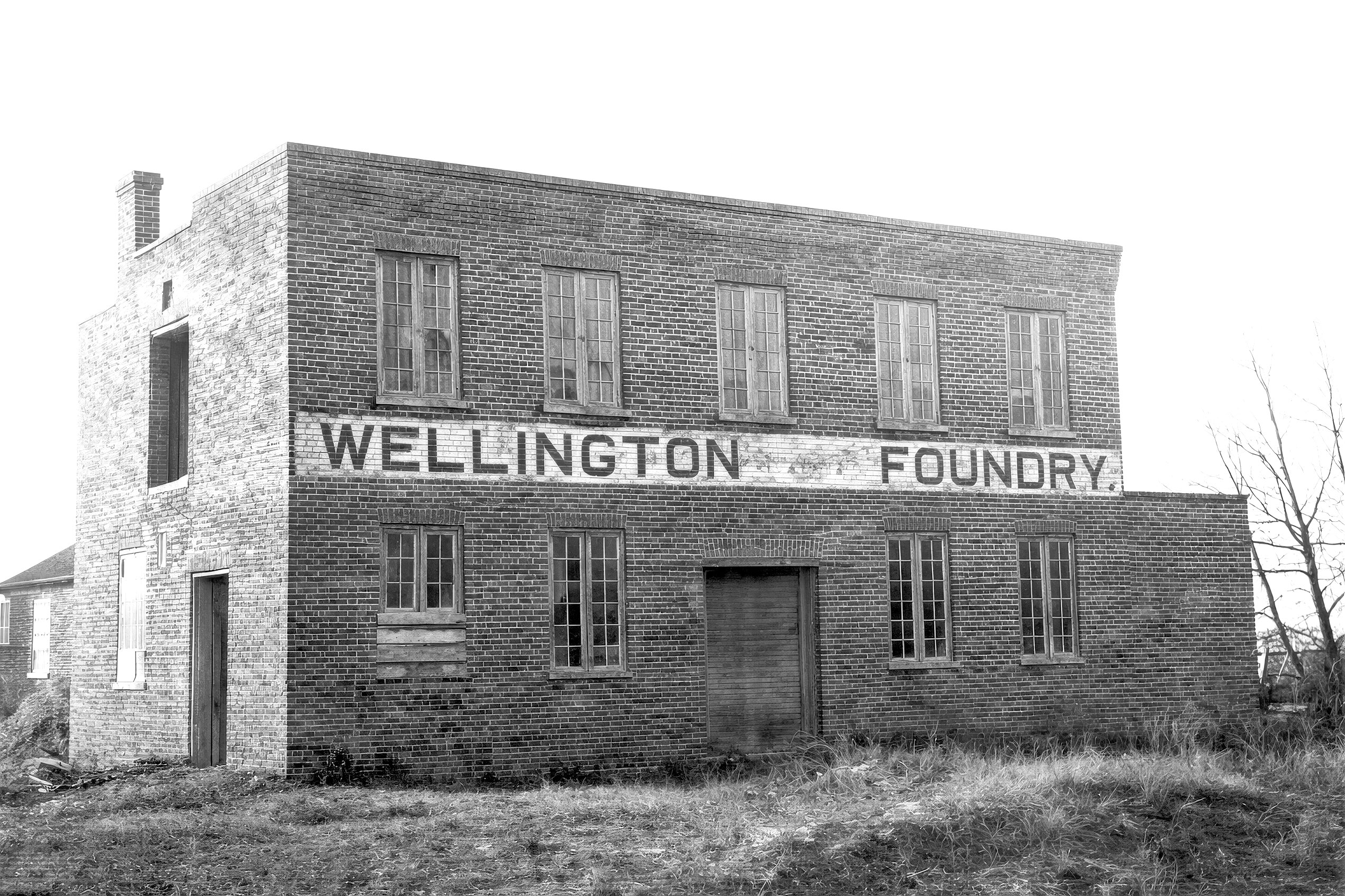
Constructed in 1864, the Wellington Foundry rose as the village transitioned from a pioneer settlement to an established agricultural hub. Local farms were expanding, soil was being worked harder, and machinery— not just muscle—was making the land more productive.
They wanted a big building for a foundry in Wellington because it served the surrounding area,” said Margetson. “Wellington had the biggest foundry in this end of the County.”
According to Margetson, the building itself was a statement of permanence.
“It was four wythes of brick, English bond. It was robust. That’s why that building is there today,” he said.
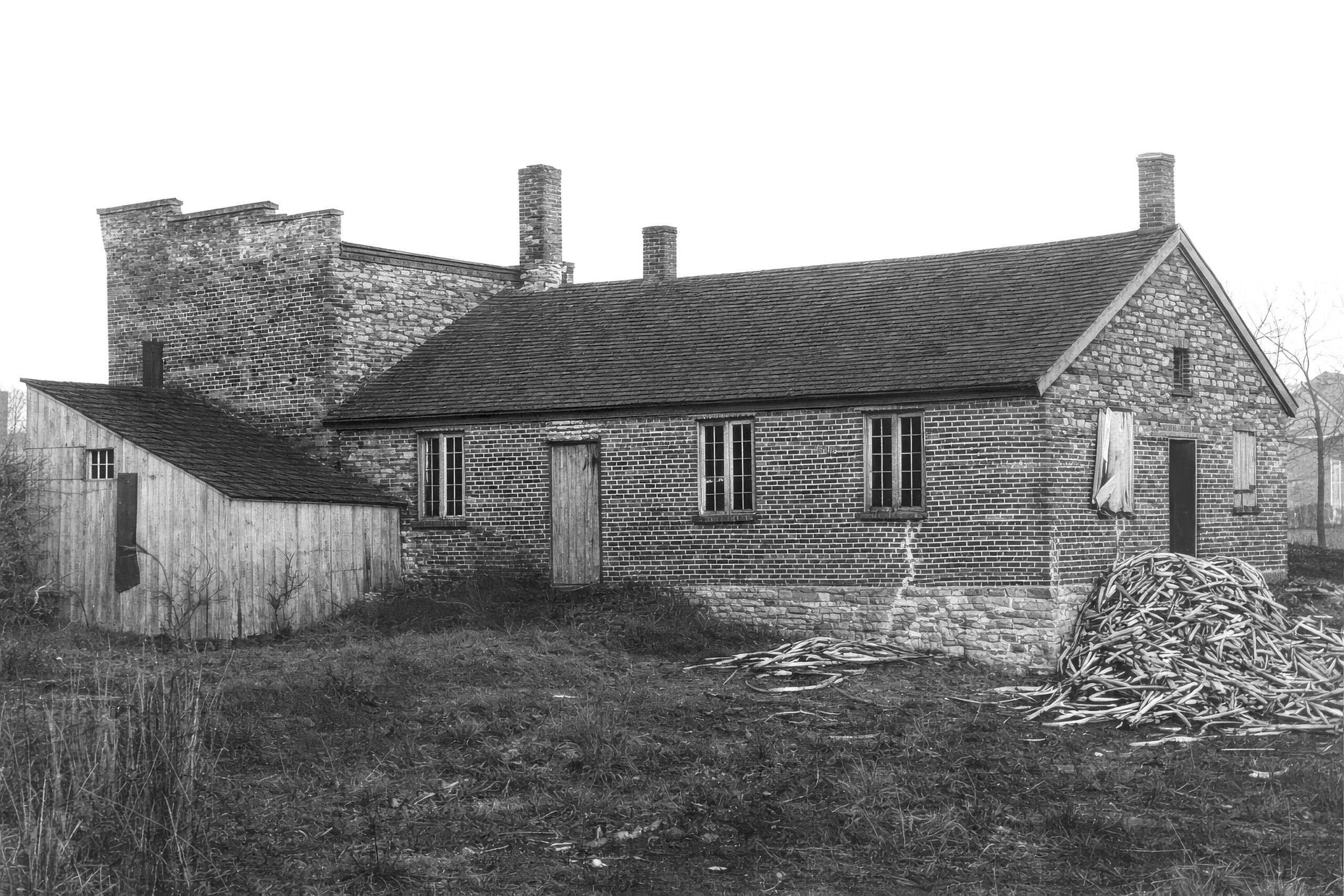
Those four layers of brick made the walls nearly two feet thick in places. The English bond pattern—alternating courses of stretchers and headers—structurally locked the masonry together. It wasn’t decorative brickwork; it was industrial engineering. Brick was essential in a foundry setting. Iron casting required intense heat, and fire was an ever-present danger. The tall structure also served a functional purpose.
“You needed to get really hot to start melting the iron,” he said. “The height of the building allowed for proper draft and ventilation, drawing air through furnaces and expelling heat and smoke upward.”
Even the window choices were deliberate.
“Those windows are all north-facing. Anyone who does work in a building knows the north light is the best light,” added Margetson.
North light provides steady, indirect illumination— critical for precision work. In an era before electric lighting, good natural light could mean the difference between a properly cast part and a flawed one.
The foundry produced both cast iron and wrought iron goods, two distinct processes under one roof.
Cast iron involved melting iron and pouring it into moulds. Wrought iron, by contrast, was heated and hammered into shape by blacksmiths, without fully liquefying the metal.
The Wellington Foundry supplied farm implements to a growing agricultural economy. Walking ploughs, mouldboards, cultivator parts and repair pieces were likely among its outputs.
“A farmer could probably plough one to two acres on a good day with a walking plough,” said Margetson.
As fields expanded and soil nutrients became depleted, livestock and improved equipment became necessary. The foundry was part of that evolution, supporting farmers transitioning from basic clearing to sustained production.
Margetson showed an 1871 federal census industrial schedule that listed 18 industries operating in Wellington at the time, including the iron foundry.
That’s a striking number for a small lakeside village. It suggests a community that was not merely agricultural, but diversified—with carriage works, sawmills, tailoring shops, and blacksmiths operating alongside maritime trade.
The foundry would have been loud, hot and labour-intensive. Workers handled raw pig iron, operated furnaces, poured molten metal and shaped heavy equipment—all without modern safety standards.
It also relied on the broader transportation network. Iron and coal could arrive by schooner. Finished goods were transported via wagon or ship until the railway arrived in 1879.
“It changed everything, gradually,” said Margetson.
Access to larger urban factories, greater labour pools and more advanced machinery undercut small rural foundries. Industrial production began to centralize.
By the late 19th century, the Wellington Foundry was no longer competitive at the same scale. Ownership shifted, and operations slowed. Eventually, industrial production ceased altogether.
Yet unlike many similar buildings across Ontario that were demolished once their purpose ended, this one survived, likely owing to its construction.
“That brick building is essentially still there.”
REINVENTION UNDER W.P. NILES
When Wellington entrepreneur W.P. Niles acquired the property in the early 1900s, he chose not to demolish the massive structure, but to convert it. He commissioned W.F. Fitzgerald to make several changes to update the building, yet the bones of the foundry remained embedded in the finished renovation. The transformation was significant.
Tall industrial parapets were removed. A severe roofline was softened. Portions of the original brick were covered in stucco, a common Edwardian-era aesthetic choice that shifted the building’s appearance from utilitarian to domestic.
What had once been a place of smoke and molten iron became a private lakeside residence.
Behind modern finishes and renovations lie the thick brick walls designed to contain furnaces, the structural proportions intended to vent smoke and heat, and the footprint that once housed the iron heart of Wellington.
“Quite a character in Wellington,” said Margetson of Niles. “He took risks and did a lot of different things in his lifetime.”
Niles operated a major seed business from Wellington, exporting peas and beans across Canada and overseas. He also generated local electricity using waterpower from Lane Creek and steam backup.
“Things were changing, and he took advantage of the situation,” added Margetson.
The conversion was substantial, but carefully executed.
“Look at the outcome. You need a good client that can pay for it, and a good project, and you can get a good result in the end,” said Margetson. “That brick building is essentially still there.”
Niles’ investment was also a statement about Wellington’s future. Transforming a foundry into a home signalled a pivot in the village’s identity, from production centre to permanence. It reflected confidence that Wellington was worth investing in, even if its economic character was changing.
THE INN ERA
Over time, the building transitioned from a private home to a nursing home and eventually to hospitality use—part of a broader trend in Wellington’s identity, from an agricultural support community to a visitor destination.
Its thick brick walls, north-facing windows and layered history made it an attractive candidate for adaptive reuse once again.
Just as Niles had reimagined an industrial building as a residence, later owners reimagined that residence as an inn. Over the decades, the property served as Clinton Lodge, a retirement home, tourist accommodations, and the Devonshire Inn bed-and-breakfast. It adapted as Wellington itself evolved from an industrial village to a tourism destination.
MODERN RENOVATION
The building’s most recent major transformation began after its purchase in 2011. Margetson was involved in the current iteration of the building.
“It was supposed to be a week, and then I was here for two years,” Margetson said with a laugh.
Margetson was hired as an engineer to oversee the renovation. The work was extensive.
“We really didn’t know where to start. It was quite a big job. I started looking at the floor, because it needed structural work, and I found some really interesting old blacksmithing tools buried underneath,” said Margetson.
The 2011 work did not replace that structure. It worked within it. Interior systems were upgraded— plumbing, electrical, and HVAC—bringing the building into compliance with modern codes while retaining its load-bearing brick shell. That is often the most expensive and technically demanding aspect of adaptive reuse—fitting 21st-century infrastructure into 19th-century construction without compromising integrity.
Floors were removed, new foundations poured, and bedrock anchors drilled to support the modern cantilevered dining room, which Margetson calls a full-circle moment.
“Structural steel was a big part of an old foundry,” says Margetson. “And now it’s holding up this building we are sitting in.”
The property is likely to experience further transformation as the current owners look to expand the inn.
Margetson thanked the WCA for hosting the event, and Tom Wiltse and the late Marjorie Wiltse for sharing her photograph collection. He also sent special thanks to Jessica Chase at the Prince Edward County Museums and Krista Richardson at the County Archives.
“We have to support our archives. There is a lot of history there; it accumulates and needs to be catalogued and made accessible. I appreciate that.”
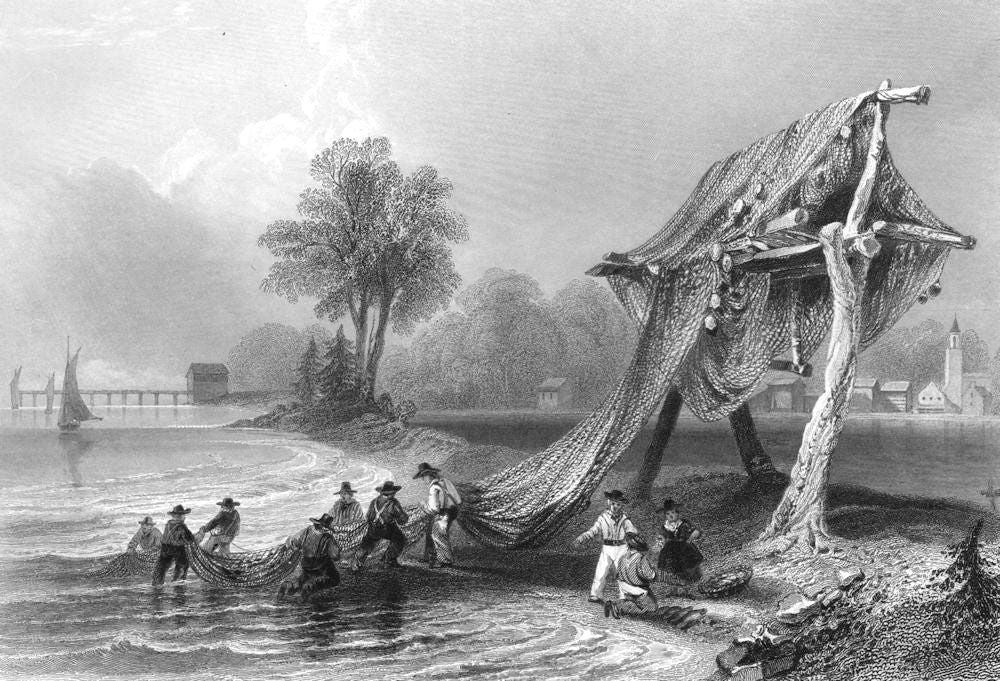
Wellington, on Lake Ontario, Prince Edward County, by William Henry Bartlett. An 1842 antique steel-engraved print.
Comments (0)