
County News
Persnickety
Housing Authority approaches a crossroads
Twelve years ago, Scott French sailed on his 32-foot craft out of Sodus Point, near Rochester. A week later, his boat, Persnickety, washed up on Point Petre. The sails were up. Food and cash remained on board. But no Mr. French. Despite a massive search effort, French was never found.
I was reminded of his story watching the Prince Edward County Affordable Housing Corporation (Housing Authority) Board meeting last week. The board continues to drift along, seemingly unaware that no one is at the helm. It is adrift. Soon it will run aground—and when it does, it seems, those still on the board will be taken completely by surprise. In fairness, some board members see their salvage efforts as noble— they have come this far across the lake, they are going to see it through to the bitter end. Other members, however, are banking on a combination of wishful thinking, winning a lottery and an “educational framework”, that might yet bring this wayward craft to safety.
THE INCREDIBLE SHRINKING PROJECT
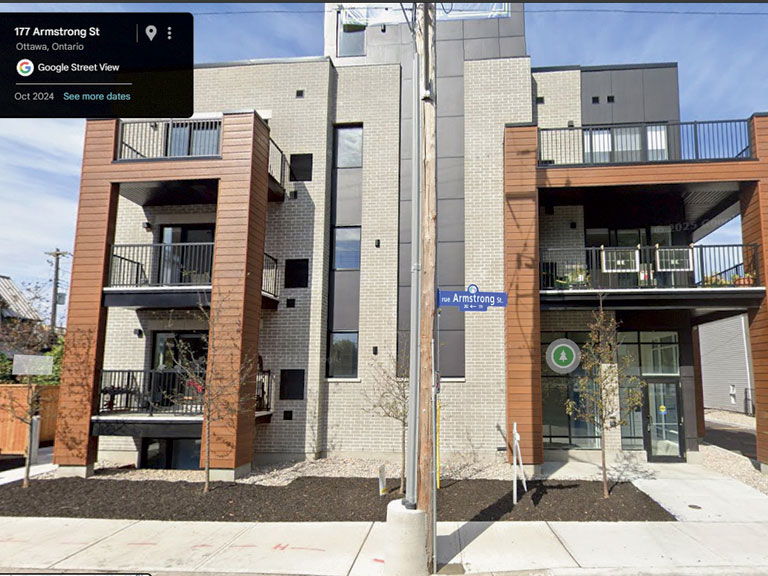
The Disraeli Street project envisions an eight-unit modular apartment building on a lot owned by the municipality in Picton. In the beginning, the hope was that all units would offer affordable rents. But the numbers didn’t work. The plan was revised. Four would be offered at market rents; the remaining four would be rented at affordable rates (set at 80 per cent of market rent). But still, the numbers didn’t work. So the board is now considering three affordable, five at market rents.
Closer, but not yet viable.
Among the nest of problems is that neither the board nor the Housing Authority have figured out how to finance the project. Appeals to funding agencies have failed. The Housing Authority is now considering borrowing the money, but it hasn’t yet secured a lender.
It figures it will have to pay interest on a 45-year mortgage in the range 3.5 to 4.7 per cent—a big range—but it has not yet secured a funding deal.
As it stands currently, the Housing Authority must borrow nearly the entire $2.7 million needed to build the eight-unit apartment block. The Housing Authority has no meaningful assets or collateral, so the municipality will have to guarantee any borrowing.
Still, cash flow from the proposed rent—even at five market, and three affordable units—likely won’t meet a lender’s viability test (proof that the Housing Authority can make its payments).
It is at this point a responsible organization might acknowledge a good effort—but barring a miracle—was near the end of the road.
Indeed, the County’s Chief Administrative Officer, Adam Goheen, suggested they might already be there.
“My feeling on this is that we are really going to need some grant funding,” said CAO Goheen to the Housing Authority board. “The numbers don’t work. It’s way too risky.”
He praised the board’s hard work but did not see a path forward unless or until Build Canada, CMHC, or another funding agency comes through with a big cheque.
“We really need to lower our capital costs to provide more affordability and less risk for this model. I don’t see us working without that,” said Goheen.
Board members weren’t yet prepared to give up, however.
CLINGING TO DEBRIS
Public board member Hilary Spriggs had rolled up her sleeves in recent weeks, working with municipal housing department officials to hammer out a pro forma (a forecast of future cash flows) tool to test the project’s viability.
Spriggs argued that the numbers were close, and that a few tweaks to revenue (perhaps higher rents), lower capital costs, and an infusion from the Housing Authority’s cash reserves might make the project viable.
“I do think there is a way forward,” said Spriggs.
Later in the meeting, CAO Goheen attempted to lower expectations for a significant cash injection from reserves. He was reluctant to speak categorically without the finance director present, but neither did he want members to assume there was a pot of money at their disposal.
“I don’t believe we have very much free cash,” said Goheen. “We owe the County for the Wellington demolition.” He promised to bring more definitive information to the next meeting.
Councillor Kate MacNaughton suggested the board take another shot at fundraising in the community to nudge this project forward.
She suggested a fresh start, perhaps a bond issue, working with The County Foundation. “Perhaps we could achieve affordability through a complementary model,” said MacNaughton.
Housing supervisor Elis Zeigler reminded Mac- Naughton that previous boards had tried fundraising — that it would be hard to do and expensive to pull off.
Undaunted, MacNaughton insisted that staff “explore pathways forward.” She suggested assigning people to approach some local organizations.
“It would be good if there were some outreach,” said MacNaughton.
CAO Goheen agreed.
“I’m happy to have this conversation again,” said Goheen.
The conversation turned to the mundane. Should parking be an additional fee? Should a couple of pro formas be prepared? Pending landing a lender? Should the board present a wish list to Council?
To this final point, board members generally agreed that their plan should be ‘rock solid’ before appealing to Council.
CAO Goheen interjected to remind the board they were at a crossroads. He recommended a special meeting in two weeks to address the serious, fundamental challenges. Who would lend the Housing Authority the money? At what rate? What are their eligibility requirements? There were other issues about waiving connection charges that had to be sorted.
“We need to get this pro forma squared away,” said Goheen. “The bank is the big thing, then the pro forma—then depending on the conversations with the bank, we should have a special meeting just to talk about this project.”
He didn’t explicitly describe the meeting as a go or no-go session—but he didn’t need to.
Would two weeks be enough?
“It is yet to be determined,” said Supervisor Zeigler in response.
Comments (0)