
County News
Preferred beach plan
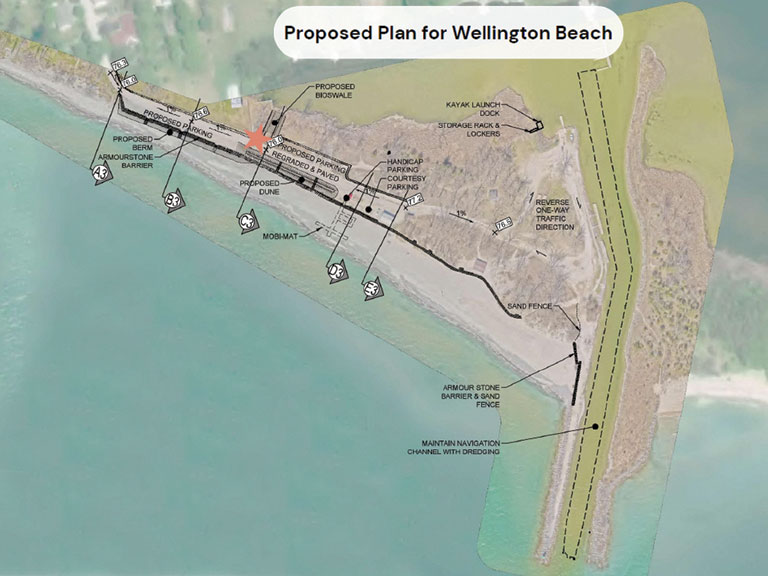
Phased plan targets flooding, drainage and access issues at Wellington beach
Wellington Rotary Beach, one of the County’s most-visited waterfronts, is a step closer to a long-term makeover after Council approved the preferred beach improvement and management plan at last week’s committee of the whole meeting.
“Wellington Rotary Beach is a big feature, especially to visitors to the County—sometimes it’s the first thing, or maybe the only thing, they see when Sandbanks is too full,” said Councillor John Hirsch.
The plan aims to tackle long-standing issues such as flooding, drainage, sedimentation, and road deterioration, while maintaining the natural character of the site. However, no construction can begin until funding is secured.
“This is a culmination of exploring management options for the beach,” said Albert Paschkowiak, the County’s supervisor of Environmental Services and Sustainability. “It consolidates all the past reports, studies, and consultations that have been done with residents.”
Paschkowiak described the strategy as a “cost-conscious, minimalist approach” to resolving key problems such as sediment build-up in the channel, poor drainage, and deteriorating infrastructure. The County plans to seek grants and complete the work in phases as funding becomes available.
Dredging remains the first priority. The County will continue to hire a contractor every three years to dredge the Wellington channel, while staff explore purchasing their own dredge to reduce long-term costs. Dredging operations, which typically cost around $220,000, are expected to resume next year.
Hirsch also introduced an amendment directing staff to include a reserve for climate adaptation and mitigation projects in the 2026 budget. The funds would help the municipality qualify for a Federation of Canadian Municipalities (FCM) climate adaptation grant, which could cover up to 70 per cent of eligible project costs.
“FCM won’t accept an application unless we can show we have the remaining 30 per cent available,” Hirsch said. “That should enable us to do some of the major start-up items quickly—possibly as soon as next year.”
Paschkowiak noted that improvements to the road and drainage system would likely qualify as climate adaptation work. “We’re looking at proper drainage, raising the road, and incorporating a bioswale, so stormwater doesn’t sit and erode the surface,” he said. “Everything else depends on fixing that first.”
KEY ISSUES AND COSTS
The preferred beach plan addresses three main concerns: channel sedimentation, infrastructure damage, and user access. The replacement of the asphalt road, including re-grading and drainage upgrades, is estimated at about $510,000.
“These features will work in concert to improve drainage and resilience to flooding and storm surge,” Paschkowiak’s report noted.
Councillor Janice Maynard expressed concern over the cost, saying, “It’s going to be a tough sell at half a million dollars when the roads we drive on every day are in worse condition than that beach road.”
The plan also looks to long-term solutions for sedimentation. Options include extending the jetties into deeper water ($5.7 million) or purchasing dredging equipment ($1.1 million). While jetty extensions could reduce the need for future dredging, they come with a long payback period and high risk if sediment continues to accumulate.
An overland barrier—a stone wall and sand fence—can be implemented sooner under existing funds and could help reduce sand from blowing or washing into the channel.
PUBLIC ACCESS, PARKING, AND NATURALIZATION
Beyond the technical fixes, the plan aims to improve access and safety for beach users. A proposed berm would formalize parking areas and create a natural barrier against flooding and vehicles driving onto the sand. A boardwalk extension would run along the top of the berm, improving pedestrian movement.
A section of parking would be shifted to the north side of Beach Street near the former water filling station, while the old parking area would be replaced with a naturalized dune. Drainage would be handled through a bioswale leading to the nearby marsh.
Not all councillors supported the dune concept. “Part of the attraction to going there is being able to drive down and look at the water,” said Councillor Brad Nieman. “You put something there that obstructs that view—I can’t support that.”
The plan also includes a reconfigured traffic flow near the boat launch and a new kayak launch with floating dock and secure storage, though Nieman objected to the municipality storing private equipment. “I don’t believe the municipality should be in the business of renting or storing people’s property,” he said.
PROVINCIAL PARTNERSHIP
The beach operates under a management agreement with the Ministry of Natural Resources and Forestry (MNRF) that runs until 2041. While MNRF generally supports the proposed improvements, additional permits and detailed designs will be required.
However, Councillor Phil Prinzen raised the idea of handing the beach back to the province, noting it was mentioned in the staff report. “Have we threatened to give it back to them so maybe they’ll help us out?” he asked.
Paschkowiak confirmed it’s an option, but cautioned against it. “It would remove the municipality’s ability to manage the site and could result in a drop in service levels,” he said. “We can’t purport to know what the ministry would do—it’s a bit of a nebulous option.”
Hirsch agreed, warning that if the County handed it back, “it would just languish in its current state while the province did studies and planning.”
COMMUNITY SUPPORT
The beach management study, prepared by Shoreplan Engineering Inc., was based on extensive public consultation, including more than 1,000 survey responses. The Wellington waterfront task team evaluated three approaches: tweak, naturalize, or big move. Of 166 detailed responses, 73 per cent preferred moderate improvements or naturalization over a fullscale redevelopment.
“This has been a great example of public consultation,” said Wellington councillor Corey Engelsdorfer. “We hosted multiple open houses, knocked on doors and even attended a Wellington Rotary meeting. This is likely the first time I have felt confident we have reached the public in order to help us form a decision.”
The County has been reviewing beach operations since 2021, prompted by surging tourism during the pandemic. The resulting plan, Council heard, aims to balance environmental resilience with accessibility and community enjoyment.
“The beach is a centrepiece for the County,” said Hirsch. “If we want to protect it, we need to take action now.”
And according to this article, we’ll get to see what’s coming up for 2026 taxes soon:
https://www.quintenews.com/2025/11/10/prince-edward-county-prepares-interim-tax-levy/
And here’s what happened:
https://www.quintenews.com/2025/11/11/county-approves-interim-tax-rate/
But the article shares no details other than there was a plan approved.
We have to go to the actual agenda of the Council meeting to see the “plan” –> https://princeedwardcounty.civicweb.net/filepro/documents/?preview=339925
The document there is not a “plan” in any detail. But, is does state that Staff is asking for $20,976,916 to be raised by the first tax installment of 2026, which is due in mid-March. That represents one third of the estimated tax requirements (BEFORE THE BUDGET MEETINGS EVEN TAKE PLACE).
This equates to over $62.9 MILLION for the year, from property taxes (AGAIN, BEFORE THE BUDGET MEETINGS EVEN TAKE PLACE).
For context, the same meeting topic last year was in the Agenda for the Nov 26, 2024 meeting –> https://princeedwardcounty.civicweb.net/filepro/documents/?preview=317521
In that meeting, the interim tax levy requested by Staff was $19,820,365. This equates to over $59.4 MILLION for the year.
So, that means that Staff has asked for a tax levy increase of 5.9%, EVEN BEFORE THE BUDGET MEETINGS EVEN TAKE PLACE.
The Bank of Canada says inflation these days is near 2.0%. For reference, you can see that inflation has not been at or near 5.9% since early 2023 –> https://www.bankofcanada.ca/rates/price-indexes/cpi/
So, the spending continues, as we pass the $100 MILLION annual spending mark for a rural County of 25,000 people.
Excellent point SM … Council seems to be selling the various options other than “status quo” pretty hard, likely because they will not be able to secure any Federal or Provincial grants to do any of the options.
This leaves them with only two choices, regardless of which option they vote for (or allow the “Strong Mayor” to push forward). Either spike property taxes up again, or borrow yet more money on top of the crushing debt we already have (or both, hoping to hide the numbers and “kick the can down the road” again in terms of financial prudence.
A Councilor is quoted as saying “The beach is a centrepiece for the County,”
But that Councilor, the Mayor, Staff and other Councilors, have made developer-led projects the centrepiece of massive spending of County funds. Of $100M+ per year at the current run rate for operating expenses, a huge part pf the money is being driven by the effort to remake the County in the image of a GTA-style suburb. That Councilor is also on record as saying he will not stand for re-election, although of course that could always change.
We can only hope for a new Mayor and Council in next year’s election that has the courage and discipline to stop the madness and right-size the County government to what the County is — a small jewel that is NOT a GTA-style suburb.
Go back and read the article particularly paragraph 3. You will find this: “However, no construction can begin until funding is secured.” It ‘seems’ that the County intends to seek funding from other levels of government or perhaps a donor. It does not appear that there is a plan to finance this out of tax revenue nor further debt.
Councilor says it is a big feature especially to visitors to the County!! Only if we can afford it. If it was to be done then finance it through the 50% MAT Tax that goes for tourism.
The same could be said for the lights being proposed in Picton – the locals get that section (by Books & Co.). Let the MAT pay for installation, upkeep.
Tax, Borrow, and Spend. That’s the current Council playbook.
How does The County propose to pay for this?