
County News
Protecting a watershed
WCIA launches legal challenge over Cold Creek approval
The Waring’s Creek Improvement Association (WCIA) has notified the municipality that it intends to challenge Council’s approval of the Cold Creek subdivision in the Ontario court system.
The WCIA argues that Council lacked the authority to make this decision.
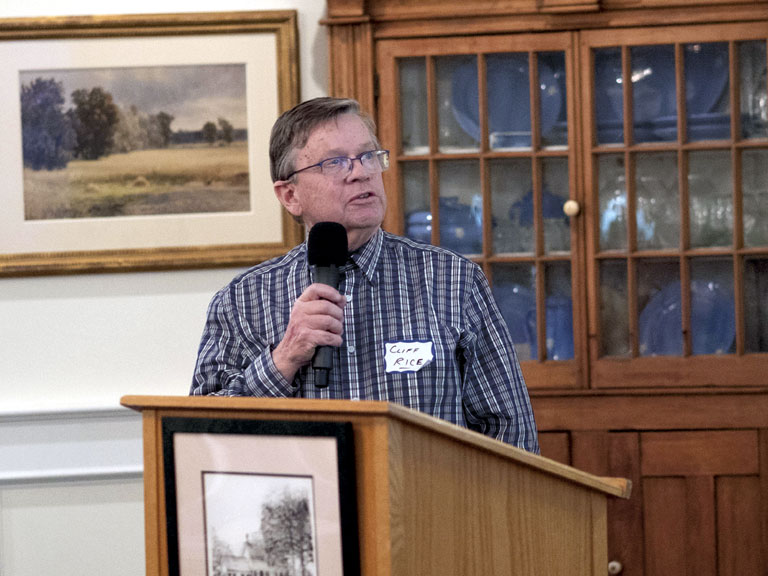
“The matter was under appeal by Cold Creek, and before the Ontario Land Tribunal (OLT), at the time of the purported Council decision,” says Cliff Rice, president of the WCIA. He contends the municipality was obliged to stand down as the developer’s appeal ran its course.
In 2024, Council denied the developer’s application. The developer appealed to the OLT in December.
The following February, Council chose to short-circuit the process and instead struck a deal with the developer, enabling the Cold Creek subdivision to proceed. Some council members feared that a loss at the OLT would limit Council’s ability to steer the prospective subdivision and that they would be cut out of future decision-making.
So it was that Council approved a revised subdivision proposal in February last year. The plan calls for an 870-unit residential development bordering Sandy Hook Road and County Road 1.
Council approval came with the condition that the developer conduct a comprehensive hydrogeological assessment of the Cold Creek project property. For some on council this was seen as a partial victory.
The WCIA, however, contends that the municipal council ceded authority over the file in December 2024 after Cold Creek filed a notice of appeal to the OLT.
“As the OLT appeal was still active on that date, Council lacked the legal authority as the file was before the tribunal,” says Rice.
They intend to test their argument in a courtroom.
“The real frustrating thing here is how the municipality has gone about this,” says Rice. “We want any development on these lands to be guided by science. It’s been a real rush job.”
As such, he contends his group and the broader community have lost confidence that the municipality will protect this watershed.
LOYALIST HEIGHTS GETS ANOTHER LOOK
Council hoped to avoid the OLT making the Cold Creek subdivision decision. But it turns out the OLT may be a better steward of this land.
Earlier in 2024, the developers of the Loyalist Heights subdivision—a plan encompassing about 400 homes next door to the Cold Creek project— had already appealed to the OLT by the time Council was considering the Cold Creek file.
The OLT, in a bit of a surprise move, is currently seeking to mediate the issues on the Loyalist Heights property.
“We have been party to a three-way mediation process with the County and Loyalist over this development,” says Rice. “The process and content are completely confidential. The settlement reached between the three parties requires that a one-year study process, with WCIA review, be completed before any development can occur.”
Rice believes the Cold Creek project and lands should undergo the same scrutiny.
“If all things were equal, the Cold Creek Development would enter the same type of process with WCIA review.”
FOCUS ON PROTECTING WARING’S CREEK
For more than 30 years, a group of County residents have worked to protect and rehabilitate Waring’s Creek and its watershed. Few ever imagined the biggest threat to the fragile ecosystem would be Shire Hall and municipal council.
Since its founding in 1993, the WCIA has led extensive restoration efforts, including tree plantings, erosion control and habitat improvements, contributing to measurable gains in water quality and ecosystem health. While much of that work has been carried out quietly by volunteers and environmental experts, the group has taken a more public role in recent years as large-scale residential developments have been proposed near the creek’s watershed and headwaters.
The WCIA has repeatedly explained the risks of paving over the watershed to Council. The group insisted that Shire Hall conduct its own independent study of groundwater conditions to determine, once and for all, the challenges of intensive homebuilding on these 150 acres—so that it could assure all County residents that the developers’ plans were defensible and safe. Council had already committed to doing so in a 2008 settlement with the WCIA—but in the intervening years, Shire Hall has wriggled out of this obligation.
According to Rice, the WCIA was assured it would be an active participant in determining the tolerance of this land for development, including the number of homes, density, and watershed protection and mitigation measures.
Instead, the group was marginalized and largely precluded from the review process, according to Rice.
According to the WCIA president, this type of court case has never been tried in Ontario before, but the WCIA was left with no other option—and it will be an expensive one.
“We have tried to mediate with the County, but we have gotten as far as we can go,” says Rice. “If we win in court, what is already in motion on those lands will come to a stop. The approval will be invalid. We are looking for a site alteration freeze and for the developer to reapply and start at the beginning with public consultation. Let the science guide what the land can sustain, and it could end up looking totally different.”
A crowdfunding site has been set up at Waring’s Creek Restoration and Defence Fund. For more information on how to donate and get involved, please visit waringscreek.ca
Cheryl Anderson made an informative comment on countylive.ca under “Protecting A Watershed”. I suggest everyone read it.
Sorry about that – the countylive.ca article was “Waring’s Creek group disputes legality of Cold Creek Approval
What does that comment quoting the Official Plan really mean it terms of the development?
I’d suggest emailing the WCIA and asking them directly.
https://waringscreek.ca/
Didn’t this same Council do something similar with Picton Terminals? I thought they were heading to Court, and the next thing I read was that Council decided to sign something with PT?
I think the County is in a real mess! This could get real serious.
This absolutely should be “real serious”.
Successive Councils have failed to protect this watershed. The Official Plan Steering Committee – Agricultural Advisory Committee who were engaged from 2014-2018 had three members of Council actively and officially engaged in the OP. Those three remain on Council today – along with four other current members of Council for all three terms of office. And yet, the protections for this watershed was by-passed?
If I’d been one of those WCIA members who’d been working so hard to protect this watershed, I’d be demanding an explanation. Come to think of it, I guess I am – as should we all.
Absolutely no excuse.