
County News
Recycling transition bumps
Curbside collection for businesses ends
Regular visitors to municipal dumps will have noticed some big changes in recent weeks. Meanwhile, businesses that were accustomed to putting recycling at the curb each week have noticed the truck no longer stops anymore. Other residents have discovered that their recycling gets picked up on a new day, altering their weekly household routines.
It’s a lot to take in for a community used to doing things a certain way. Change is unsettling.
The story begins in 2019 when the province decided to put greater responsibility for the costly business of recycling upon the producers of products and packaging. While the transition has been underway for a couple of years, it was mostly invisible to residents.
That all changed earlier this month when Quinte Waste Solutions handed the keys over to two different contractors.
The residential blue box program in Prince Edward County is now the responsibility of Circular Management Ontario (CMO), which has contracted with E360 Solutions for the collection of residential recyclables. For some residents, it means their pick-up day has changed (A map showing new collection days may be downloaded at: www.circularmaterials.ca/resident-communities/ prince-edward-county/)
Commercial recycling—from businesses, institutions and industrial operations—will no longer be picked up at the curbside. It is now the responsibility of these businesses and institutions to bring recyclables to municipal landfill sites, where they can be disposed of for free.
New methods also bring new language. Gone are cans, bottles and plastics—all are now considered containers under the new recycling regime. Paper, cardboard, and similar materials are now referred to as fibre. (Styrofoam is no longer considered recyclable at all.)
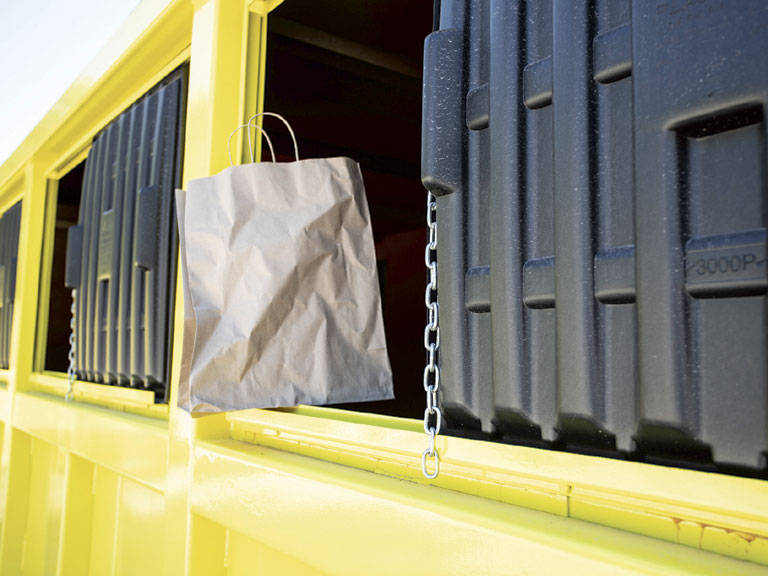
It also means new bins at the landfill site. Rolling bins have been replaced by three large steel bins—one for residential containers, another for residential fibre and a third dedicated to commercial recycling.
The decision to end curbside collection for businesses is financial. When the province transferred the responsibility for recycling to producers to manage their own recyclables, the municipality was presented with a dilemma. Business owners were accustomed to the municipality picking up their recycling along with everyone else. Transporting these materials—or paying someone to do so—represents a new permanent expense to these businesses.
But the municipality could not afford to send another fleet of trucks fanning across the County to pick up commercial recycling. The cost was prohibitive. Too much geography. Too few businesses. Shire Hall examined an array of options, and landed on opening up waste sites on additional days and providing free drop-off to these businesses.
The risk whenever change occurs in recycling and waste management is compliance— that recyclable material will revert to the garbage stream, while some may end up on rural roadsides.
In response, municipalities are pressing the province to do more to assist industrial, commercial and institutional organizations to continue to divert their recycling waste.
In a letter to the province, AMO (Association of Municipalities of Ontario) president Robin Jones urged Queen’s Park to facilitate municipal reengagement with businesses and organizations to “support a more efficient and effective system.”
Shire Hall admits that it has been a challenging few weeks.
“We want to thank the public for their patience and understanding during the transition,” said the municipality in response to the Times’ questions. “If you are having an issue with your recycling collection, please call 1-866.358.3560.”
The Wellington waste site will continue to collect wine bottles and beer cans on behalf of the Wellington Rotary Club.
Comments (0)