
County News
What’s plan B?
Water rate-setting committee has questions
Cracks are beginning to open up on the panel setting future water rates. There is a growing worry among some members that its role and purpose could be sidelined by events, project momentum and Shire Hall’s single-minded focus on spending in excess of $300 million to expand waterworks in Wellington to serve Bloomfield and Picton. Some members worry this may be leading their work down a dangerous road.
At least two of the public representatives on the County’s Water and Wastewater Rates Community Committee want to discuss alternatives.
“How do we get to plan B?” asked Chris Ryerson, public committee member. “We are not having the discussion we need to be having.”
Ryerson, representing the views of many residents, worries that the scale of the proposed project, the enormous risk involved and the underlying premise of massive population growth in a community that hasn’t grown in 150 years, puts the project’s viability in doubt.
“When do we get to plan B?” asked Ryerson. “And when are we talking about it?”
The Director of Water and Wastewater Services, Don Caza, assured Ryerson and the committee that expansion plans were founded on reliable processes, informed by an expert engineering firm, and comprehensive in scope.
Ryerson asked about a 2014 study prepared by another engineering firm, R.V. Anderson, that concluded the “preferred alternative” for Picton water was from a new intake located further out into the bay.
Director Caza said the findings in the most recent report, prepared by another engineering firm, CIMA, considered the 2014 report and that its conclusion superseded the previous report. Director Caza implied the CIMA report was more comprehensive in scope. (CIMA looked at all six water supply systems in the County. However, its reporting on Picton water sources is just 33 pages. Meanwhile, the 2014 R.V. Anderson report runs to 73 pages.)
GROWING QUESTIONS
Another public member, Bob Cooke, praised the briefing memo supplied by the Wellington Community Association (WCA). He suggested that when done well, communication is a two-way street, and decision-makers should listen as much as they talk.
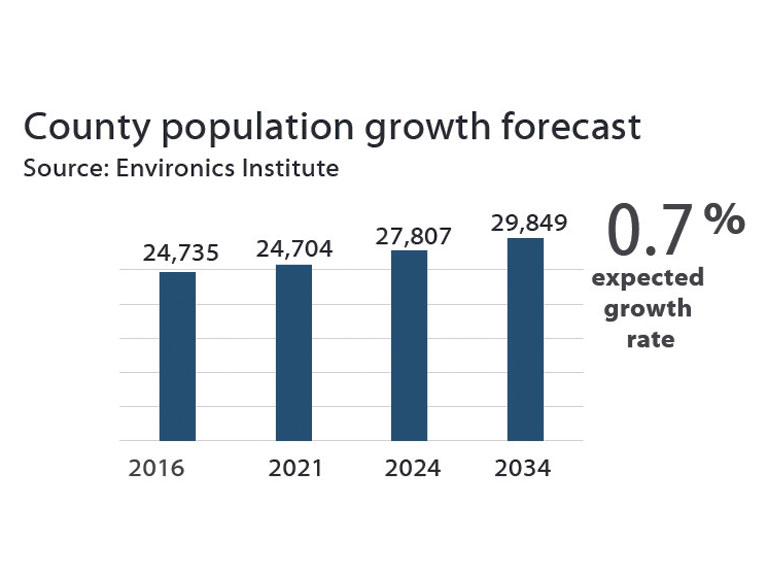
The WCA memo is a thorough, step-by-step examination of population growth prospects. Relying on data from the federal and provincial governments and Shire Hall consultants Watson and Associates, the WCA memorandum concludes that the County’s population is most likely to grow at a rate averaging 0.7 per cent per year. It’s a level consistent with historic growth in Prince Edward County. At this rate, it will be more than a century before the population arrives to use—and pay—for the proposed $300 million system.
Cooke wanted to know the source of the population numbers used in the Regional Water Supply Servicing Master Plan (RWSSMP) produced by CIMA.
Manager of Engineering David MacPherson said the growth numbers used to specify the size of the water system had come from Watson and Associates.
But that isn’t what the RWSSMP says.
According to CIMA’s report, the size of the plant and system was based on the Picton Development Plan for Commercial and Institutional developments provided by The County (December 2022).
It’s a critical distinction. The scale of the proposed project is based on a Shire Hall document. It is not from CIMA, Watson, nor any other expert advisor.
Much is riding on the County’s population, arising from a century of no growth, to suddenly surge upward by thousands of new residents, triggering Picton, Bloomfield and Wellington’s population to explode by a factor of five. If it doesn’t happen and the County spends $300 million, there will be no refund. The risk to the utility and existing users is potentially ruinous.
WHAT ISH? WHEN ISH?
Cooke had more existential concerns about the committee and its work. Earlier in the meeting, the committee heard from Director of Finance Arryn McNichol, who explained that it was his target to prepare a recommendation to Council on July 24 regarding the regional water project. That prompted questions about the committee’s role in shaping the recommendation.
Director McNichol sought to quell worries that the committee would have no opportunity for input before Council decided the matter. He said his July report was likely to be limited to a “factual report” about the municipality’s debt and how the County intends to finance the $300 million project.
Cooke tried to clarify the committee’s purpose. He did so with a list of polite but direct questions.
“What is our deadline? What would water rates look like if we set them tomorrow? He pressed the Director of Finance for more details about his recommendation and when it would be available to the committee.
McNichol said there were too many unknown variables to answer the question directly. He noted that Watson and Associates is currently redoing its population assumptions, based on lower expectations of population growth. These numbers would feed the development charges study. McNichol added that recent changes to development charges by the province also had to be worked into the financing plan.
As it stands, the committee tasked with setting water rates will learn the fate of the most expensive project ever contemplated in Prince Edward County when everyone else does—after Council makes its decision.
Comments (0)