
County News
County debt poised to surge
New report shows borrowing capacity remains, but future obligations are mounting
How solid are the County’s finances? The municipality is racking up unprecedented debt. Its spending plans continue apace even as the demand picture for expanded infrastructure is deteriorating.
Meanwhile, the municipality took a $1.9 million hit in 2025—a deficit “driven by wage pressures, higher H.J. McFarland service demands, and lower cost recoveries”.
The County has the capacity to borrow more and to spend more, but should it?
UNANSWERED QUESTIONS
The County’s auditors reported this week that, while the municipality remains well within the Province’s legislated debt payment limit, its structural obligations are set to grow substantially as major water and wastewater projects move from construction financing into long-term debt.
“Overall, the County’s current debt remains manageable and within Provincial borrowing requirements,” wrote Arryn McNichol, Director of Finance, in his report to the Audit Committee this week.
But there remain two big questions: Does big capital spending still make sense in the current context? And will the County’s outlook remain buoyant when the County’s debt spirals six times higher, as it is projected to do over the next two years?
THE NUMBERS
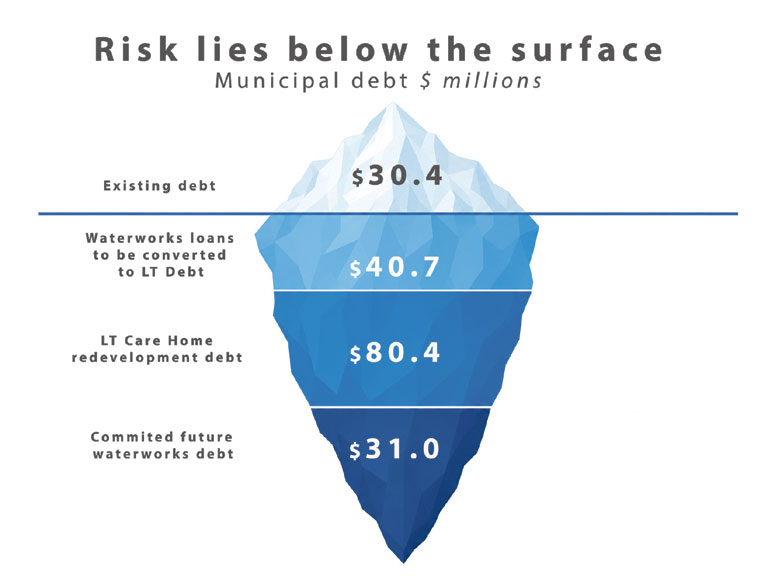
The County ended 2025 with approximately $30.4 million in long-term debt. But it is just the tip of the iceberg.
Waterworks loans currently totalling $40.7 million (money already spent) will convert to long-term debt this year. Another $80.4 million will be borrowed to fund the redevelopment of the H.J. MacFarland home. Yet another $31 million in waterworks borrowing has been approved but not yet drawn down.
All told, the County’s debt pile is expected to top $182.5 million by the end of 2027. This is new debt that has already been committed. More spending plans remain on the table.
According to some provincial comparable sustainability measures, the County was already considered to be carrying moderate risk at the end of 2024. Its predicament has deteriorated in the past 18 months.
Last summer, the County’s auditor, Katie McMahon, at KPMG, an accountancy, cautioned the Audit Committee about the municipality’s capital spending plans. McMahon’s concern then was not so much about the County’s financial position on that day, but rather where the municipality was heading in terms of spending.
UNDER THE LIMIT
According to Ontario’s annual repayment limit (ARL), the County has approximately $15.1 million in additional annual debt repayment capacity. That means it can spend this much on paying down debt before the Province intervenes.
The County’s existing annual debt charges are approximately $4.81 million. These costs will rise substantially in 2026 and 2027.
On paper, it still leaves considerable room.
But the provincial limit is not a measure of affordability— it establishes how much a municipality can commit to debt repayment before requiring provincial approval. It does not address whether taking on additional debt is prudent, given the other demands on a municipal budget.
Nor is the Province a disinterested party—it is motivated to see municipalities offload it of spending, particularly infrastructure spending it would otherwise be required to fund.
BIG SPENDING CONTINUES
Shire Hall is continuing to pursue major infrastructure investments in water, wastewater, roads and other municipal assets. It is doing so in a context in which its financial position is already under strain.
Much of the County’s debt has been described by staff as “strategic” borrowing—investments intended to generate future benefits or revenues.
Water infrastructure is an example.
The municipality is investing heavily in Wellington’s water and wastewater capacity with the expectation that additional development will follow, generating development charges and other revenues. But that revenue depends on development occurring as anticipated. It is also dependent on the timing and scale of growth.
The question is when (or if) the investments will ever pay for themselves, and how much of the cost will ultimately fall to taxpayers and ratepayers? The new report does not provide those answers.
McNicholl’s report indicates that a five-year debt-service forecast, a reserve forecast, and an interest-rate sensitivity analysis are still under development.
OTHER RISKS
Interest rates also remain a risk. Future borrowing will be undertaken at rates available when the money is actually borrowed, while existing debt includes both fixed and variable-rate obligations.
The County may have the legal capacity to borrow, but whether future councils and taxpayers have the financial capacity to carry the resulting obligations is a different matter.
It is a question the County’s auditor raised last year. It was a caution repeated by Municipal VU, a consultancy, in June, when it reported that County “property taxpayers are already paying a heavy load of the costs, compared to other municipalities.”
With tens of millions of dollars in additional debt now moving closer to the balance sheet, the question is becoming harder to ignore.
The Audit Committee meets this Thursday at 3 p.m. via Zoom.
What a damned mess this Administration is leaving for the Incoming Council. This “Old Boys Club” really has to go. With the Mayor now leading that charge, wouldn’t it be nice to see a clean sweep and some new leadership in most of our the Wards? Many in this Council have been at the Horseshoe for two and three terms now [8-12 years!!!]. They haven’t fixed any of this yet – well past time for a new crew. As for one member of Council, who shall be nameless, stating “where are the residents in all this”, over the last budget talks – he hasn’t been paying attention. The residents are fed up with not being listened to!