
Comment
How?
The runaway train of waterworks infrastructure spending has, for now, been slowed. In this lull, we need to understand the foundational mistakes made and how a bad premise cascaded into years of poor infrastructure planning. How was it permitted to get so close to a catastrophe?
To be clear, the municipality has spent $50 million in aid of a single developer in Wellington. That money is gone. Water customers are paying most of this bill. The developer paid $12 million, in exchange for control of the remaining capacity in the village’s waterworks system. Damage has been done in the name of a grand, deluded vision.
But it could have been much, much worse. Until last month, Shire Hall was still planning to spend seven times that amount—all on the backs of 5,200 water customers. It would have been ruinous. We can see that now. Predicted it much earlier. But how did we get here? And why did it take so long to bring this train under control? And critically, has the threat really subsided? Or can it roll to life again?
We now know that Shire Hall based its big spending on wildly unrealistic population growth. Its forecasts contradicted the history of this place, government population trends and expert opinions. But even after Shire Hall’s growth projections were debunked, its spending plans remained intact. Only the pace of construction changed. How could this be?
 Long after the senior leadership who promoted the defunct growth figures left, Shire Hall kept pushing the super regional water plan. $360 million. Over eight years. About $70,000 per household served by municipal water. Development charges would soar, meaning builders would abandon the County for lower-cost neighbouring jurisdictions.
The foundation for Shire Hall’s plan kept falling apart— yet municipal staff continued to promote the doomed regional water system. We need answers.
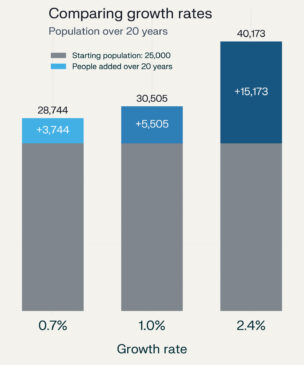
To understand how badly it fell apart, you need to know the difference between a one per cent growth rate and a population growing at 2.4 per cent (this was Shire Hall’s made-up growth figure used to support a regional water plan) as measured by actual humans.
If the County’s population were to grow at 2.4 per cent, starting from 25,000 people, it would add 15,173 after 20 years (a widely used timeline to guide infrastructure plans). If true, it would prompt a proper review of system capacities.
But if the population grew at just one per cent—the dialled-down rate that Council agreed to in January for planning purposes— it would add only 5,500 residents over two decades. It’s a big difference.
Inexplicably, however, the preferred solution produced in 2024 using 2.4 per cent growth remained unchanged in 2026 at the more realistic prediction of one per cent population growth. It wasn’t credible. (The costs, the debt and charges, however, would be shared across a much smaller number of heavily burdened residents.) Yet the regional water plan dragged out an expensive financial modelling exercise all summer. Unsurprisingly, the result was unaffordable and unworkable. So Council rejected it.
But the risk is even greater: While a one per cent growth rate may serve as a reasonable planning number, it is most certainly overstating the County’s growth prospects. Remember that the County’s population has remained stubbornly flat for 150 years.
Moreover, Shire Hall’s demographic consultant, the province’s ministry of finance and others currently peg Prince Edward County’s growth rate at 0.7 per cent per year. If that holds up, that’s just 3,750 more folks after 20 years, for a total population of 28,750-ish.
These are radically different prospects. They require different plans.
Consider one more trend. In 2026, just seven per cent of new homes are being built in municipally serviced areas (urban areas with water and wastewater services). Most new homes are being built in the countryside. The implication is that 93 per cent of the new folks—at least in 2026—aren’t waterworks customers and never will be.
The gravity shaping the County’s table-top flat population is abundantly evident. The premise of rapid growth must be discarded as the fantasy it always was. Always has been.
Lingering questions remain: How did a plan that imagined hundreds of millions of dollars in spending based on unrealistic growth projections survive for five years? How did it threaten the financial viability of this community until last month?
Q: How did a plan that imagined hundreds of millions of dollars in spending based on unrealistic growth projections survive for five years?
A: A number of reasons:
1) The narrative of “Growth pays for growth” (which is, and always was, a fallacy) was pushed onto Staff by smooth-talking outside developers and their consultants. Staff then, pushed that narrative to Council and the Mayor. Not everyone on Council believed that narrative, but they were in the minority, as a sub-group of Councillors, together with the Mayor, and egged on by Staff, used it as the basis to approve plans and Motions that required ever-increasing spending and borrowing. The excuse Staff used, and will always continue to use, was “You, Council, approved this, so it’s not our fault.”
2) Together with this, the narrative of “We have to trust our Staff” began to be proclaimed by some members of Council, and that began to take hold within Council, probably because no one wanted to question the opposite — i.e. “We don’t trust our Staff.” It’s OK to question Staff, and it ought to be OK to listen to your constituents, many of whom are more knowledgeable than Staff, or even the consultants hired by the developers. But Council steadfastly ignored deputation after deputation, and the direct and indirect feedback they were getting from their constituents.
Some of the Councillors who parroted these narratives are returning for sure to the new Council, because they have been acclaimed (no one ran against them). And they may still believe these things, despite all logic and evidence to the contrary.
Other Councillors who echoed these narratives are running for re-election, although they have competition.
With the abysmal voter turnout here in the County (never reached 50% in any election in this century), incumbents have a natural advantage. In situations where voter turnout is so low, over 80% of the time in Ontario municipalities, the incumbents are re-elected.
It remains to be seen whether or not:
1) The eligible voters in the County actually care sufficiently to get out and vote; and
2) They are sufficiently in the mood for change, to vote for a challenger rather than the people who surrounded the horseshoe while we got into this mess.
Those are the questions I’d like to see the answers to. We’ll know in 11 days. Advance voting is this Saturday, day after tomorrow, and election day is Oct 16. No excuses. Vote!