
County News
Marsh Creek bioblitz
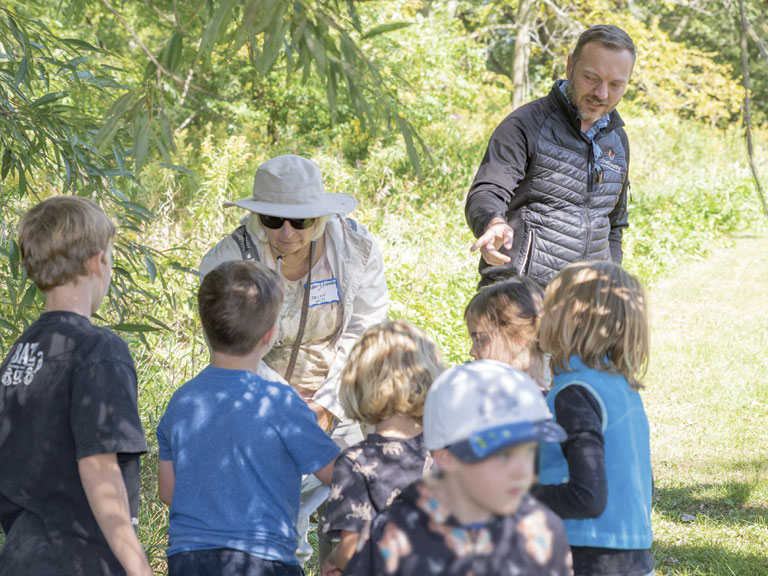
Survey of biodiversity organized by Feral Folc and PECFN
Community members and subject matter experts gathered in Delhi Park over the weekend to conduct a biodiversity survey of Marsh Creek in a collaborative project between Feral Folc and the Prince Edward County Field Naturalists (PECFN) sponsored by the Canadian Wildlife Federation (CWF). Over Saturday and Sunday, participants catalogued observations on the natural life in and around Marsh Creek using the iNaturalist app, as well as taking part in workshops and activities aimed at providing a better understanding of this hidden gem within the town of Picton.
Becky Lamb from Feral Folc said that Marsh Creek was chosen as the area for study because it is readily accessible to the community, and that this survey was part of the Great Canadian Bioblitz being conducted over the past two weeks by the CWF. She added that this was only one of five projects funded by the CWF, in part because of the potential for greater public involvement. Cédric St-Amour of PECFN said this was a perfect opportunity to collaborate with Feral Folc, which has the goal of bringing people together to explore and help to preserve the environment. “In a bioblitz, we invite members of the community and experts to come together and identify as many species as we can in that location, within that timeframe. It is a capture of the biodiversity in this area. Biodiversity is a really important marker for ecological health. The more biodiverse and area is, the healthier it is,” he said. The data recorded by participants over the weekend will be used to issue a report to the CWF, and will be made available of the PECFN website, as well as shared with the Mohawks of the Bay of Quinte as part of ongoing reconciliation efforts.
The events of Saturday began with a presentation by students from Wildhearts Forest and Nature School about the importance of listening to and caring for the local environment. They offered observations on plant and animal life, as well as how to identify some harmful invasive species. Mr. St-Amour was thrilled with the student participation.
“I’m very passionate about this. It’s important to involve young children in learning about nature,” he said. Other events on Saturday included several different walks to identify trees, butterflies and dragonflies, wildflowers, invasive species and moths, and there were several telescopes set up for observing the sun.
Liz Driver of the Prince Edward County Heritage Conservancy gave a talk on the history of Marsh Creek over the past two hundred years, from its time as a portage route to East Lake and the changes wrought by growing industrialization of the area through the nineteenth century. At times through that century there was a sawmill, a tannery and a foundry that used water from the creek. At the turn of the twentieth century, the area around the creek became the town dump. The mounds of garbage became home to hordes of rats, and Ms. Driver said the town offered a contract at $140 per year for rat control. A fire at the dump led to its closure, and the area was reclaimed for recreational use. “Human interactions over 200 years have been ad hoc and often to the detriment, but nature is rebounding in this space,” said Ms. Driver.
One popular workshop on Saturday was about the use of natural dyes to make coloured inks. Artist Christina Zeidler makes natural inks using plants, and she had a selection made from plants such as sumac, willow, buckthorn, curly dock and black walnut, all of which are found in the park. For this workshop, she brought along eight different colours from among the hundreds she has at home. (“Because I’m obsessed,” she said.) The inks are made by steeping the plant or berries in water, and sometimes salt is used to help fix the colours. Ms. Zeidler said she had a lot of fun with the students from Wildhearts, and was very impressed with how quickly they took to using the natural inks. “They really were experimenting and everyone did something really different. It was exciting to see them jump in to try it out and see what happens,” she said.
The bioblitz continued on Sunday with presentations on bird migration and observation, walks to identify lichen, fungi and spiders, and a workshop on nature journalling. A report on the bioblitz will be available at pecfieldnaturalists.org at a later date.
Comments (0)