
County News
Shire Hall responds
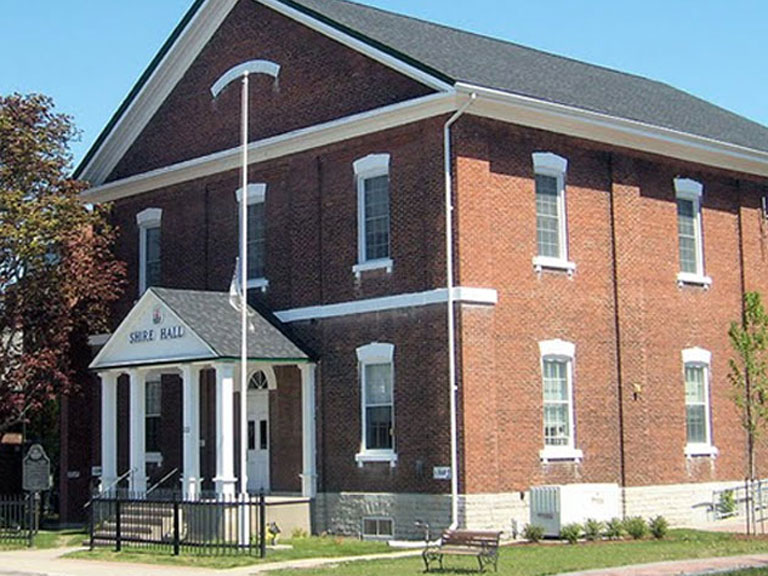
Editor’s note: In the September 2 issue of the Times, our story ‘Nudgeniks’ highlighted the complexity and possible contradictions between Shire Hall’s June report outlining various studies, Watson’s financial strategy presented on August 27 and a 2014 RV Anderson study that recommended a new intake and water plant in Picton.
In pointing to the discrepancies, we committed to giving Shire Hall the opportunity for a full response. It is presented below.
1. In the June presentation of scenarios, the No Growth scenario lists projected costs of $118 million (Watson’s funding analysis). It didn’t include an amount for expansion/upgrade to Wellington’s water plant. But the EVB condition assessment did: $20.6 million.
Taken together, the est. project cost would be $139 million. But in Watson’s current Financing Strategy (Table 14), the debt funding required to fund these projects is $218 million.
What comprises the difference?
Shire Hall response:
- The $20.6 million was an expansion to accommodate growth; therefore, this amount should not be included in the $118 million no-growth scenario.
- The costs in the June memo ($218 million) are $118 million for projected costs and $39 million for completed costs (Wellington Water Tower, Wellington Water Trunk, Wellington EQ Tank, Wellington Wastewater Trunk) for a total of $157 million. That leaves a difference of $61 million.
- Of this $61 million, $19 million was from life cycle costs identified in the County’s 20-year capital plan that were not included in any of the larger capital projects identified, and $35 million was for conversion of a construction loan to long-term debt.
- The remaining difference is a result of inflationary costs and the inclusion of various already completed studies (Schedule C MCEA for Wellington Water & Wastewater, Regional Water Supply Servicing Master Plan).
2. Meanwhile, the EVB/CIMA condition assessments tally just $47 million (Picton water: $10.6 million, Picton wastewater $2.2 million, Wellington water $20.6 million, and wastewater plant $14.1 million) to extend capacity for 10 years.
SH: This is incorrect. The costs you have listed do not expand capacity of all facilities for 10 years.
The Picton water cost of $10.6 million is an optimization strategy as opposed to a capacity expansion. This investment would improve existing treatment processes and operational reliability to ensure continued operation for approximately 10 years. As stated in the EVB condition assessment, “As none of the proposed process improvements will impact the rated capacity of the plant, no environmental assessment is required based on the Project Tables in the 2024 Municipal Class Environmental Assessment.”
The Picton wastewater cost of $2.2 million is only lifecycle costs and does not expand the capacity of the existing plant.
The Wellington water cost of $20.6 million is an expansion to accommodate the 25-year 1.0 per cent growth scenario in Wellington only (not regional).
The Wellington wastewater cost of $11.1million is only to keep the plant operational with the same capacity. $14.5 million is required to meet already allocated capacity. Therefore, $25.6 million would be required for the plant to remain operational and meet its current allocated capacity.
The $47 million tally doesn’t include a new intake in Picton, nor does it include the eventual rehabilitation of the Picton water plant.
. However, according to an RV Anderson report from 2014, the combined cost of a new plant and intake in Picton was $28 million ($22 million for the plant, $6 million for intake). When inflated to 2026 dollars, this tally is $37.6 million.
SH: It appears that 2.5 per cent inflation has been used to increase costs from the 2014 amount. This inflation rate is significantly lower than the historical non-residential building construction inflation rate of approximately 3.5 per cent documented through Statistics Canada. Using 3.5 per cent, RVA’s estimate would be $ 42.3 million in today’s dollars.
It should be noted that $ 42.3 million is only construction costs and does not include any Environmental Assessments, Detailed Design, Contract Administration, Site Inspection, Geotechnical Investigations, or Internal Staff Costs. etc. These additional costs could be in the range of $5-8 million above and beyond the construction costs, bringing the total 2026 costing for RVA’s alternative to $47.3-50.3 million.
From our review of the detailed costing breakdown in RVA’s report, there also does not appear to be any construction contingencies accounted for, with a typical 20 per cent contingency on large capital projects. If this were included, it would bring RVA’s total to $55.8-58.8 million.
This results in a difference of $15.2-18.2 million from the estimates presented for option 2C at the June 25 Committee of the Whole meeting.
However, RVA’s 2014 study also assumed that the existing plant could be expanded on the existing footprint, which is a flawed assumption, and does not consider the additional costs of a raw water pipe to an alternative location within Picton (due to limited County-owned land adjacent to Picton Bay). Therefore, the costs presented in RVA’s 2014 study are generally comparable to what has been presented in recent reports when adding the cost of piping raw water.
It should also be noted that the 2014 RVA Environmental Assessment has expired and would be unable to be used. A new Environmental Assessment would have to be completed and include all the known source water threats, which have likely changed since 2014.
Recommendations in this new Environmental Assessment could change the location/cost of the new intake, with the likelihood of a reduced or same cost option being unfeasible due to updated threats to the water source.
This suggests the cost of a new water plant and intake in Picton, expansion of Picton’s wastewater, and expansion of Wellington’s water and wastewater plants is in the order of $84 million.
With the corrections identified above, total costs would still align with what has been presented by staff thus far and would not equate to $84 million. Furthermore, $ 84 million only expands Wellington & Picton Water and no wastewater facilities, or any of the water distribution upgrades needed to service growth that have been accounted for in our detailed scenario breakdowns.
4. So what is the actual project cost to expand the capacity in Picton and Wellington to accommodate 1 per cent population growth? $84 million? $139 million or $218 million. (Please don’t muddy the tally with lifecycle or maintenance costs–those may be spelled out and presented in a separate list.)
SH:
- $84 million was calculated based on an incomplete water expansion plan and no expansion plan to the wastewater infrastructure.
- $139 million was calculated based on no growth but included a growth expansion to only the Wellington Water Plant.
- $218 million is the no-growth scenario with costs detailed above.
For the actual project cost to expand capacity in Picton and Wellington to accommodate 1.0 per cent growth, please refer Watson’s Base Scenario in their report presented at the August 27th Committee of the Whole meeting. This same report also provides the costs for the 2C (local water plants) scenario for comparison.
5. Follow-up question: Why isn’t the delta (in either above) spelled out and explained in the Financing Strategy?
The figures being compared come from different scenarios and scopes, and in some cases are measuring different things. As a result, they aren’t directly comparable. The reconciliation above is intended to clarify those differences.
Comments (1)