
County News
Story in 3 charts
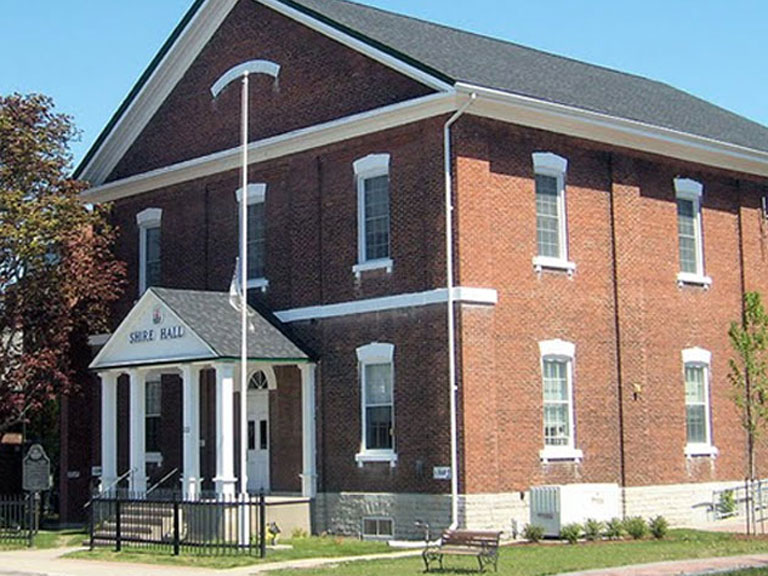
County finance director walks a tightrope
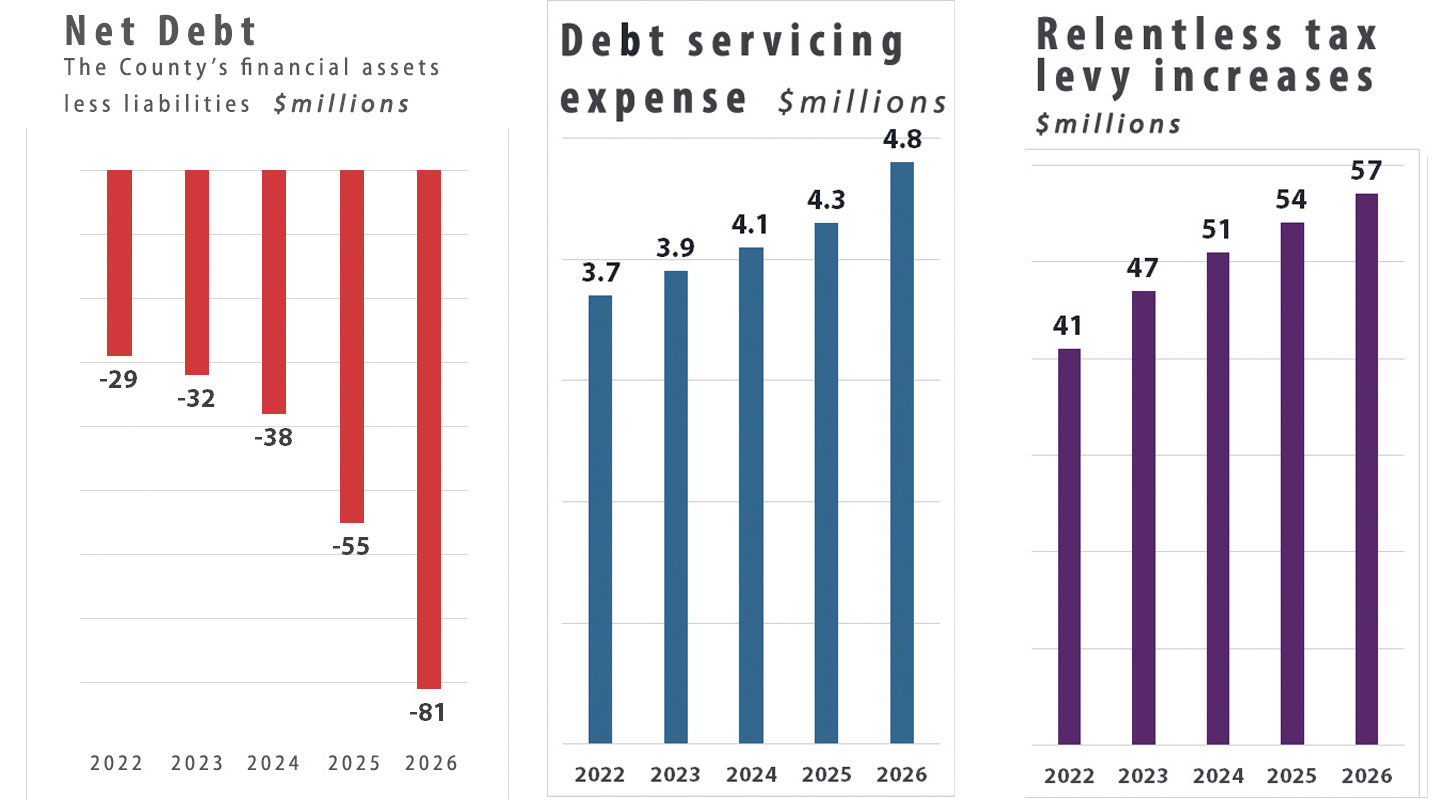
The cost of funding the County’s growing mound of debt has risen 30 per cent since 2022. Net debt—that is, financial assets less liabilities—expanded dramatically again in 2025. Meanwhile, the tax levy—the amount extracted from property taxes—continues to march higher every year, rising an average of eight per cent annually since 2022. The $54 million collected in 2025 wasn’t enough—as the County finished the year with a deficit of $1.9 million.
It’s a trajectory that is expected to continue for several years. More spending, more debt, higher taxes.
Choices made in this term of council to dramatically increase roads funding and to expand waterworks infrastructure are now hitting the County’s finances. Current spending includes ongoing (never-ending?) work to install waterworks trunklines in Wellington, the development of a new long-term care home on the H.J. MacFarland site in Picton, and an ambitious amount of road work.
Much more spending is in the works, despite persistent questions about need, timing and who will pay.
FUNDING THE PARTY
Since 2022, the cost to service the County’s rising debt burden (principal and interest) has risen 30 per cent to $4.8 million. Paying down debt now consumes eight per cent of the tax levy. It will continue to rise, as ongoing construction loans are converted to longterm debt.
The worrying bit is the amount of spending Shire Hall still has on the drawing board. For example, a regional water system could, if approved, add at least another $250 million to the pile.
The County’s finance staff is looking to blunt the impact of bold new spending by offloading some of the upfront costs onto developers. But a similar plan backfired badly in Wellington, where a developer paid $13 million toward $50 million of infrastructure—but now controls all new homebuilding in the village, with no incentive to build. The village is arguably worse off—much higher water rates with no new homebuilding on the horizon.
DEBT
While the municipality’s debt is growing it remains well under the limits set by the province. Further borrowing flexibility was created by 2023 when an Ontario Land Tribunal ruled that debt that potentially recoverable through development charges (waterworks infrastructure) or provincial funding (long term care home, could be exempted from its limit.
While the County’s rising mound of debt does not put it offside with the province, it remains a matter of concern for residents and water ratepayers who must underwrite its borrowings and make debt payments.
The County’s softening financial position is illustrated by its net debt. Most organizations aim to maintain a store of financial assets (cash, securities, reserves they have on hand) to balance their liabilities (money they owe). The County, however, is on the wrong side of this balance—and fading.
In 2024, the County’s liabilities exceeded its financial assets by $55 million. Net debt grew to $81 million last year. It is likely to worsen in 2026.
The fact of a net debt position isn’t, in and of itself, a signal of danger; rather, it is a function of an organization that is spending money at a high rate of speed. As the County’s Finance Director Arryn McNichol notes, spending on strategic assets—those that might produce a return or provide benefit to residents for decades—may be justifiable in the short run.
“The County is currently in a period of significant capital investment, including water and wastewater infrastructure and the long-term care redevelopment, so some increase in debt-related indicators is expected,” explained Dir. McNichol.
McNichol knows, however, this trend can’t continue unchecked. He is working to find an appropriate balance that gives the municipality the financial flexibility it needs to build big things while managing the risk that offsetting revenue (development charges) may not be recovered at a sufficient and timely rate. It is a significant risk.
“There is a timing and cash flow risk when infrastructure is built before all of the development charge revenues are collected,” said Mc- Nichol. “Finance is currently modelling the timing of development charge revenues against debt payments, including the potential impact of slower growth. A timing difference does not mean the cost ultimately falls to ratepayers or taxpayers, as development charges continue to be collected as future development occurs.”
He says upfront payment arrangements can help, but ultimately big infrastructure investment relies on a leap of faith that growth will transpire, at a pace that keeps up with debt payments. Such faith, however, must be based on the County’s track record rather than the promotional aspirations of developers.
DOING BETTER
His presentation to the audit committee last week on the occasion afforded Arryn McNichol the opportunity to tout process improvements made in the past year in the County’s Finance department.
According to the report, the enhancements achieved in the past year focus on “strengthening internal controls, reducing manual processes, improving data quality, and modernizing financial systems.”
The changes range from mundane time-saving measures to more profound initiatives that promise to enhance efficiency across County operations.
Some examples:
Instituting electronic funds transfer (EFT) now means that an accounts receivable clerk doesn’t have to drive to the bank and stand in line to deposit a cheque. The department has also consolidated 150 individual Hydro One accounts into a single summary billing.
Dir. McNichol estimates that such measures have saved hundreds of hours—time that may be used on more productive efforts. But the benefits extend beyond the hours saved.
“Reducing manual handling and duplication, improving the timeliness of financial information, strengthening controls and freeing staff [is enabling them] to spend more time on analysis, forecasting and financial planning rather than transactional work,” said McNichol.
Among the more far-reaching changes, the Finance Department has launched nightly updates to its budgeting system. It enables managers to access more timely reports and respond faster and directly to changing circumstances.
Taken together, improvements in the department “support proactive financial management and improve the quality and timeliness of information available to senior leadership and council for decision-making.”
Taxes in Prince Edward County are unfair to regular people.
Homeowners here pay 90% of all the property taxes in town.
Local families and seniors are paying for almost everything themselves.
We cannot fix this by trying to build big factories. We do not have the Highway 401 corridor, and we do not have the massive water systems that Belleville and Quinte West have. Major new corporations are simply not coming here, for logical business reasons.
Since we cannot bring in massive new business revenue, Council must stop spending so much money.
For the year ended Dec 31, 2025, your local government spent over $4,000 per resident to run itself.
The focus for the new Mayor and Council needs to be on cutting waste inside town hall, lowering our operating costs, and stopping the endless red tape that hurts our existing local businesses.
We must learn to live within our means.
Stop the bloat, rein in the debt, and get back to basics.
Elect a Mayor and Council that will accept realities, stop catering to outside developers and consultants, and demand greatly simplified and clarified budget and financial processes.
And for heaven’s sake, vote!
https://www.thecounty.ca/government/election/information-for-voters/
“The fact of a net debt position isn’t, in and of itself, a signal of danger.” –> SAID NO TAXPAYER, EVER.
Borrowed money costs interest — a lot of it.
Interest gets the County ZERO benefit.
“… an organization that is spending money at a high rate of speed” is fine as long as the organization can control that speed.
The County cannot. It has set in motion many projects that offer little benefit to taxpayers, and all sorts of benefits to outside consultants and developers.
STOP THE BORROWING
CUT THE BLOATING EXPENSES.
Elect a Mayor and Council that will freeze unneeded projects, slash unnecessary positions in Staff, and for heaven’s sake, don’t make decisions based on the promises and fantasies being sold to you by outsiders.
And get the Province to step up and re-take Highway 49 back, to put it in the same category as 62.