
County News
Stuck
The County must unblock Wellington wastewater capacity
Wellington’s inability to grow is tied directly to its wastewater plant. A large developer currently holds the remaining capacity (and has paid for it). Until new capacity is added, the village will remain stuck.
For three years, expansion of this facility was tied to an unaffordable grand waterworks strategy. The fever for spending $360 million we don’t have seems to have broken. So now what?
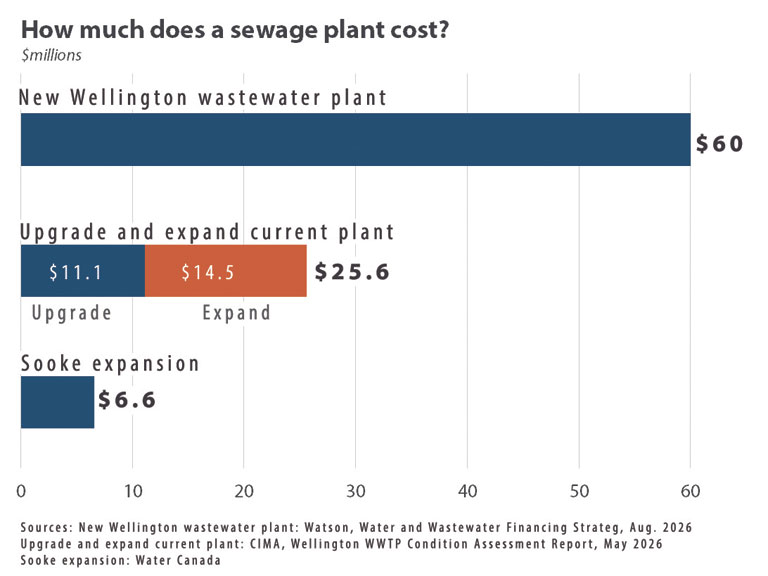
A new plant is on the books at an estimated cost of $60 million. The federal government is in for $20 million. But still it’s a lot of money.
Given residents’ experience over the past 6 years, they have good reason to scrutinize every waterworks capital expenditure. So what can we compare against?
The County built a brand-new sewage treatment plant up on a hill in Picton in 2010. The total cost was $33 million. (Original estimates figured it could be built for $16 million— itself a lingering cautionary tale of waterworks spending in this community.)
In 2026 dollars, it would cost $48 million, adjusted for inflation. So why has Shire Hall pegged the cost of a smaller plant on land it already owns so much higher?
Then there is the question of why build a new plant at all. Why not expand the current facility? It was built to be expanded. Village planners knew Wellington would grow. They anticipated expansion in the plant’s design.
How much would it cost to expand the plant rather than build a new one?
A scan of recent waterworks spending brings us to the beautiful town of Sooke, British Columbia. It is perched on a natural harbour about 40 kilometres west of Victoria on the southern tip of Vancouver Island.
In 2024, Sooke expanded its wastewater treatment plant by 50 per cent—from 3,000 m3/day to 4,500 m3/day . Adding 1,500 m3/day of capacity cost that community $6.6 million. (Adding 1,500 m3/day capacity to Wellington would, by most estimates, give the village 20 or more years of growth.)
Before expansion, the Sooke plant ran at about 70 per cent capacity. Wellington’s plant has operated at about 50 per cent of capacity over the past five years.
Sooke, like Wellington, anticipated more demand from new homes but also increasing pressure from rainwater infiltration. Both employ similar filtration and treatment methods. Sooke serves about twice as many homes as Wellington, in line with the scale of its plant before expansion
It is, therefore, hard to square the $6.6 million expansion in Sooke with the proposed $60 million cost in Wellington.
In fairness, direct comparisons are incomplete.
Wellington is an older plant—30 years older than the Sooke plant before its expansion. According to an engineering firm’s April 2026 estimate, the plant needs about $11 million in upgrades over the next five years to maintain its existing capacity. It will need another $14.5 million to expand.
Still, upgrading and expanding the Wellington plant for $25.5 million is considerably less than $60 million for a new plant. So why is a new plant even on the table?
There may be sound reasons to build a new plant. Waterworks construction costs may have risen far faster than general inflation since the Picton plant was built. Repairing and expanding the existing plant may also mean higher operating costs.
But the County’s waterworks operators, planners and engineers can no longer be given the benefit of the doubt. Every line item must face scrutiny. Every assumption must be tested and validated. Residents have a direct financial stake in the outcome.
The engineering firm that assessed the plants’ condition also prepared the now-defunct regional water plan. Its interests are demonstrably misaligned with those of the waterworks customers who pay the bills.
Nor is there time to spare. Every month of delay deepens the village’s stagnation. If the developer who controls the remaining capacity is unwilling to use it, others will. That may not mean hundreds of new homes a year, but it could mean dozens. It is not nothing.
A decision must therefore be made early next year. Whatever recommendation comes forward must withstand rigorous examination.
Comments (0)