
County News
Trail rules derail Council
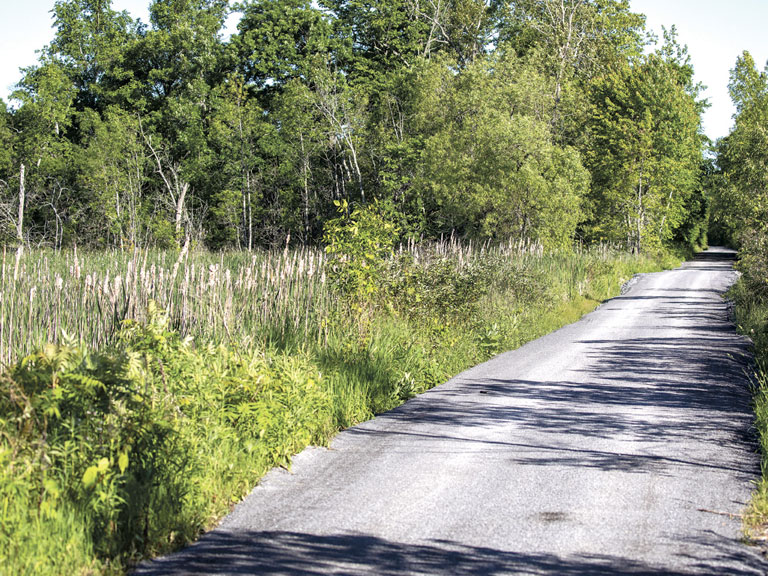
Debate over enforcement and steep fines puts Millennium Trail bylaw on hold
What began as a technical update to improve how the Millennium Trail is managed, quickly turned into a broader debate about enforcement, fairness, and the future of one of the County’s most well-used public spaces.
By the time last Thursday’s Committee of the Whole meeting wrapped up, the proposed bylaw overhaul, complete with dozens of new offences and a sweeping schedule of steep fines, had been set aside, sent back to staff for a rethink after drawing sharp and, at times, incredulous reactions from council members.
At the centre of the pushback was a simple question: how do you regulate a trail that is meant to be for everyone?
The Millennium Trail is not a typical municipal asset. It stretches across the County, used year-round by walkers, cyclists, ATV riders, snowmobilers, and horseback riders alike. That diversity is part of its appeal—but also the source of ongoing tension, as different uses don’t always coexist easily. The proposed bylaw attempted to bring order to that complexity.
On paper, it was about clarity and enforcement. Staff described it as an effort to close gaps that have long made the existing rules difficult to apply. Without clear penalties or consistent standards, enforcement has often been more theoretical than real.
“Essentially, what this new bylaw is intended to do is create a base level of enforceability,” said Albert Paschkowiak, Supervisor of Environmental Services and Sustainability.
But the tool meant to fix that problem—the fines—quickly became the focus of concern.
The draft included 63 separate offences. Some were straightforward. One hundred dollars for operating a motor vehicle without a permit, $200 for exceeding a posted speed limit, $150 for ignoring signage. Others raised eyebrows, including a $200 fine for making “unusual noise,” a term left undefined.
At the upper end, failing to stop could cost $500. For several councillors, the scale felt out of proportion— not just in isolation, but in comparison to penalties on public roads.
“If you get caught doing anything on the trail, it’s going to cost more than it does on a public highway,” said Councillor Phil Prinzen. “The fine levels are absurd.”
The reaction around the table suggested that sentiment was widely shared.
Councillor Brad Nieman was blunt.
“I am not happy with the fines.”
Councillor Chris Braney went even further, describing the document as overwhelming.
“When I looked at the penalties, I thought my head was going to explode,” said Braney, questioning both the practicality of the rules and whether they could ever be enforced in a meaningful way.
Karen Mouck of the PEC Trails Committee requesed that dirt bikes not be permitted to use the trail.
“Dirt bikes have really evolved,” said Mouck. “They are powerful and fast. Designed with speed and thrust to propel these offroad motorcycles up steep rocky inclines. We don’t think the Millennium Trail is a place for these machines.”
Mouck noted that dirt bikes cause the most nuisance and damage to the trail.
Many councillors noted that it is likely just “a few bad apples” creating the nuisance.
The question of enforcement also hung over much of the discussion.
Unlike a roadway, the Millennium Trail does not have a regular enforcement presence. Encounters with bylaw officers or police are sporadic. That reality shaped the thinking behind the proposed penalties, municipal lawyer Sarah Viau explained.
The fines, she said, were set high enough to act as a deterrent in an environment where enforcement is infrequent—where users might assume they won’t be caught, but need a reason to follow the rules anyway.
According to Viau, it’s a delicate balance. Penalties must be significant enough to matter, but not so steep that they invite constant challenges.
For some councillors, the proposal missed that balance.
Councillor Phil St-Jean framed it as an overcorrection— an attempt to solve a relatively modest problem with an overly heavy hand.
“We are being extreme in trying to correct what is probably a very minor issue,” he said. Some of the provisions, he added, were not just excessive, but unenforceable.
“This is a trail that was established for everyone,” St-Jean said. “Whether you’re on a motorcycle, an ATV, a snowmobile, horseback, or walking. That’s what this trail was set up for.”
Questions emerged about who should be allowed on the trail, when it should be used, and how seasonal changes should be handled. A proposed definition of winter, fixed from December through March, drew criticism from councillors who pointed out that actual conditions vary widely from year to year.
Similarly, while the bylaw maintained existing hours of operation from 7 a.m. to 11 p.m., the introduction of a $200 fine for violations prompted concern about whether such rules reflect how people actually use the trail.
Even the idea of user fees, raised briefly during the discussion, hinted at a larger, unresolved issue: how to sustain the trail over the long term without limiting access.
Staff noted that public feedback to date suggests fees would be unpopular. Still, Councillor Janice Maynard suggested the conversation may be unavoidable.
“This is a recreational facility,” she said. “We all pay fees to use recreational facilities.”
For now, those bigger questions remain open.
Paschkowiak emphasized that the current review was never intended to redefine permitted users, and suggested that any such discussion would require more data and broader public consultation. Who is using the trail, how often, and where conflicts occur are all pieces of a puzzle that has yet to be fully assembled.
In the end, Council’s decision to send the bylaw back was less a rejection of the idea than a recognition that the details matter—and that getting them wrong could do more harm than good.
The Millennium Trail, after all, is not just a corridor of land. It is a shared space, shaped as much by how people use it as by the rules that govern it.
Finding the right balance between access, safety, and enforcement is not a simple task.
And as Thursday’s discussion made clear, it is one the County has not yet settled.
Comments (0)