
County News
Unseen neighbours
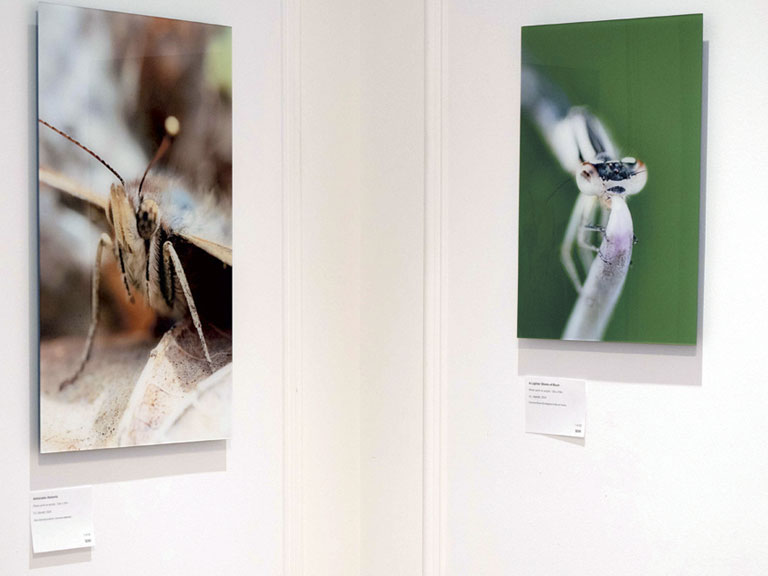
Artist GL Barrett opens a window into the world of insects
Artist GL Barrett grew up on the Isle of Wight in the UK in a gardening family. They had an early fascination with insects and adopted hoverflies as pets (although the relationship was not mutual), and they were more interested in the maggots that their father used as bait when they went out fishing. They pursued a career as a technologist and graphics designer and travelled widely. They came to Canada in 2016 for a summer visit, and became a permanent resident in 2017, moving to the County in 2022 to a two-acre property in Consecon that rekindled their interest in gardening in general and insects in particular. Their garden consists mostly of native plants, with large areas left untouched to naturalize. “That has, I think, contributed a lot to the diversity of insects that I have in the garden. I try to garden with insects in mind, because they are so important. There is just a breathtaking diversity of insects,” they said.
Mrs. Barrett started taking photographs of the flowers in her garden around 2016, using a digital camera handed down from their stepfather four years earlier. They then began to notice the insects in their photographs and realized they needed to improve their photographic skills to properly capture insects in their natural environment. With a newer camera to replace the obsolete hand-me-down and a good quality macro lens, they started their journey of insect photography. “I love the ability to capture moments that are not going to happen again. Insects are mostly forgotten— aside from the pretty ones like bumblebees and monarch butterflies. There are just so many other insects and there’s so much that’s interesting about them. They’re much more interesting than plants or bigger wildlife. You know, grasshoppers change colour over time; jumping spiders can jump huge distances because they have a hydraulic system—it’s not muscles like you might expect. When you start to learn about them, they become so much more than something that jumps out of your path or something that flutters past you,” they said. “They are our unseen neighbours. We share our spaces with them, and our gardens are their cities.”
Mrs. Barrett said that insects are actually a natural form of pest control. They point to spiders as being an example, as well as wasps and praying mantises. In addition insects are important for pollination.
“About one-third of the food you eat is thanks to a pollinator, and more insects are pollinators than people realize. If an insect moves from one flower to another, there is a possibility of pollination. Ants are also a kind of pollinator—they move seeds around,” they said. Insects are also an important food source for birds, and caterpillars play an especially large role as food for hatchlings. Mrs. Barrett said the practise of spraying insecticide to create a “picture perfect” garden is detrimental on several fronts. It harms beneficial insects as well as those regarded as “pests”, and it depletes a food source for birds. They point to Japanese beetles, which many gardeners consider a particularly bad pest that chews through foliage. “Plant a Virginia creeper which will attract Japanese beetles from your other plants. Northern wrens love Japanese beetles, and the Virginia creeper will turn into a wren buffet. That’s what I do in my garden.” They added that not using an insecticide spray will lead to a greater diversity of insect life, which will in turn attract more birds and lead to a healthier ecosystem.
This past weekend, Mrs. Barrett had an exhibition of their photographs at the County Arts Lab in The Armoury in Picton, called Here, Today, with the title being an implicit nod to the fragility of the species. Most of photographs were taken in their garden, in the insects’ natural environment. “It’s like doing street photography,” they said. The photographs are close up, and portrait-like in their presentation. They show details that are generally unseen, capturing a moment in time and space. Mrs. Barrett said that insect populations are in decline, from habitat loss, an increase in insecticide use, as well as perhaps effects due to climate change. “I’d like people to look at insects in a different way. I’d like them to consider their faces and to realize they’re not just an inconvenience. We are losing them, and we have to consider them when we have plans for our outdoor spaces. They are wonderful.” GL Barrett’s work can be found at glbarrett.com
What to hell is an unwanted Japanese Beetle?
We wish to remind you for the umpteenth time, spiders ain’t insects. They’re arachnids.